That fragmentation costs you. Missed jobs, delayed invoices, and zero visibility into which projects are actually profitable are common side effects of stitching together too many standalone apps. An all-in-one platform fixes this by combining scheduling, work orders, crew tracking, and payments into a single system.
This guide breaks down the top all-in-one platforms built for service businesses, what separates a good one from a bad fit, and how to choose the right platform for a growing crew.
TL;DR
- All-in-one platforms combine CRM, scheduling, dispatch, invoicing, and payments into one system
- Fragmented tools directly hurt profitability through missed jobs and delayed billing
- This guide compares SolvPro, Jobber, Housecall Pro, ServiceTitan, and Thryv
- Prioritize mobile/field usability, QuickBooks sync, and transparent pricing over brand name recognition
Overview of All-in-One Platforms in the Service Business Industry
An all-in-one platform for a service business combines the tools a crew needs to run a job from start to finish into a single system, instead of forcing office staff to bounce between four or six separate apps. Core tools typically include:
- CRM and customer management
- Scheduling and dispatch
- Work order tracking
- Invoicing and payments
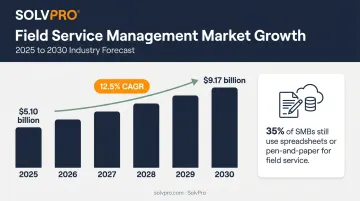
The market for this software is expanding fast. The global field service management market is projected to grow from $5.10 billion in 2025 to $9.17 billion by 2030, a 12.5% compound annual growth rate, according to MarketsandMarkets.
That growth makes sense given how many businesses are still operating without dedicated software. Among small-to-midsize businesses that recently shopped for field service tools, 35% were still using spreadsheets or pen-and-paper methods, per Software Advice's analysis of buyer interactions.
A plumbing, HVAC, or landscaping crew has different needs than a marketing-focused business. Field mobility, job costing, crew accountability, and real-time dispatch matter more than lead funnels or email drip campaigns. The platforms below are chosen specifically for businesses managing crews, jobs, and invoicing out in the field, not marketers running a sales pipeline from a desk.
Top All-in-One Platforms for Service Businesses
We evaluated each platform against five criteria: ease of use, mobile/field functionality, pricing transparency, integrations (QuickBooks and payments), and support for multi-crew operations.
SolvPro
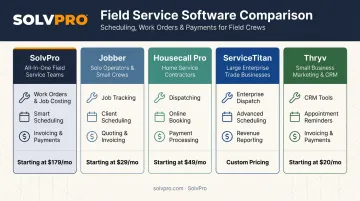
SolvPro is built specifically for growing service businesses with crews in the field , including general contractors, electricians, plumbers, HVAC companies, landscaping crews, and commercial cleaning teams. It combines scheduling, work orders, crew tracking, and payments in one system.
A few things set it apart:
- Fully bilingual English/Spanish interface across the office dashboard, mobile app, and customer communications
- Event-based geolocation tracking tied to time entries, photo uploads, and dispatch events for crew accountability
- Phase-based estimating with customer-facing PDF proposals and milestone payment schedules
- Built-in QuickBooks Online sync plus NMI payment processing, included at every pricing tier
SolvPro was built by a team with 50+ years of combined experience in construction, field service, estimating, and sales. Setup takes under 10 minutes, with live onboarding support and no long-term contracts.
| Best For | Growing multi-crew service businesses needing bilingual, field-ready software |
| Key Features | Scheduling, work orders, geolocation crew tracking, phase-based estimating, invoicing, QuickBooks Online sync |
| Pricing | Starter at $179/month (up to 3 users), Growth at $228/month (4+ users, +$49/user), Scale at custom pricing. No long-term contracts at any tier |
Jobber
Jobber has become a popular scheduling and invoicing tool for home service businesses like cleaning companies, lawn care operators, and small trades crews. It's especially strong for solo operators who need client-facing online booking and route optimization without a steep learning curve.
| Best For | Solo operators and small home service teams |
| Key Features | Online booking, route planning, quoting, invoicing |
| Pricing | Core plan starts at $29/month billed annually for a single user |
Housecall Pro
Housecall Pro leans into home service pros who want marketing automation bundled alongside scheduling and payment processing. Its dispatch tools come paired with automated post-job emails and postcard campaigns designed to bring repeat business.
| Best For | Home service businesses wanting marketing automation bundled with dispatch |
| Key Features | Dispatching, automated marketing, online payments, review requests |
| Pricing | Basic plan starts at $59/month billed annually for a single user |
ServiceTitan
ServiceTitan is positioned as an enterprise-grade platform for large HVAC, plumbing, and electrical companies with dozens of technicians. It's built around deep reporting, call booking, and financing integrations designed for high-volume operations across multiple locations.
| Best For | Large, established trades companies with big technician headcounts |
| Key Features | Dispatch, call booking, advanced reporting, financing integrations |
| Pricing | Custom-quoted per technician; no public pricing tiers, geared toward larger operations |
Thryv
Thryv combines CRM, scheduling, and reputation management into one business management platform for local service businesses. Its standout feature is automated review generation paired with text-to-pay invoicing that lets customers settle a bill straight from a text message.
| Best For | Local service businesses prioritizing reputation management and marketing |
| Key Features | Command center inbox, reputation management, scheduling, text-to-pay |
| Pricing | Business Center starts at $244/month; broader bundles start at $646/month |
How We Chose the Best All-in-One Platforms for Service Businesses
Many business owners default to software built for marketers or freelancers rather than crews physically working in the field. That mismatch shows up fast: clunky mobile apps, no crew tracking, and invoicing workflows that assume someone's sitting at a desk all day.
We weighed each platform against factors that tie directly to real business outcomes:
- Mobile/field usability: Needs to work on a job site with spotty signal, not just from a desktop.
- Transparent, SMB-friendly pricing: A small crew should see the real cost upfront, not after a sales call.
- QuickBooks and payment integrations: Does it eliminate double data entry, or create more reconciliation work?
- Onboarding support: Real person helping with setup, not just a knowledge base link.
- Scalability for multi-crew growth: Can the platform grow from 3 users to 30 without switching systems?
Get these right, and the payoff is immediate: fewer missed jobs, faster invoicing, and a clear picture of which jobs actually turn a profit.
Conclusion
There's no single "best" all-in-one platform for every service business. The right fit depends on crew size, industry, budget, and whether your office and field staff need bilingual support, not just which brand shows up first in a Google search.
Before committing to any platform, verify:
- How fast onboarding actually goes
- Whether job-costing data is genuinely visible, not just promised
- Whether you can cancel without a long-term contract
If you're ready to see what that looks like in practice, SolvPro can help you get organized and keep crews accountable, with faster payments and setup in under 10 minutes.
Frequently Asked Questions
What is the best all-in-one marketing platform?
The best marketing platform depends on your business type. For service businesses with crews, marketing features work best when bundled directly with scheduling and invoicing tools rather than used as a standalone system.
What is the best CRM for a service-based business?
The best CRM for a service business ties directly into scheduling, job tracking, and invoicing. A standalone sales-focused CRM leaves too many gaps between the office and the field.
What's the best ERP software for a service-based business?
Most growing service businesses don't need full ERP complexity. Gartner notes that field service platforms typically integrate with CRM and ERP systems, not replace them. An all-in-one field service platform covering scheduling, crew tracking, and payments usually covers what you actually need.
What features should an all-in-one platform for service businesses include?
Core must-haves include scheduling, work orders, crew or geolocation tracking, invoicing, payment processing, and QuickBooks sync. Anything missing one of these creates a gap your office has to fill manually.
How much does an all-in-one platform for service businesses typically cost?
Costs range from budget-friendly SMB tools starting around $29 to $179/month up to enterprise platforms with custom, request-only pricing. Watch for hidden add-on fees that inflate the advertised starting price.
Can all-in-one platforms integrate with QuickBooks?
Most modern field service platforms, including SolvPro, offer built-in QuickBooks Online sync. This simplifies accounting and cuts down on manual data entry between systems.