That's a risky way to run a business. When scope, pricing, or cancellation terms aren't spelled out, disputes happen, payments get delayed, and customers churn without warning. A weak agreement doesn't just cost you one job. It puts your entire recurring book at risk.
This guide breaks down exactly what belongs in a pest control service agreement, the optional clauses that build trust, and the mistakes that make contracts fall apart when you need them most.
Key Takeaways
- Written agreements protect recurring revenue, the backbone of profitable pest control operations
- Eight core clauses separate an enforceable contract from a generic template
- Cancellation and auto-renewal clauses carry legal risk in states like California and New York
- Digital contracts and e-signatures reduce paperwork loss as your customer base grows
Why Your Pest Control Business Needs a Formal Service Agreement
Recurring accounts are the financial engine of a well-run pest control business. According to the NPMA and PCO Bookkeepers' 2025 Pest Control Industry Cost Study, recurring revenue accounts for 74% of total income at pest control companies. That recurring revenue is the backbone of the business.
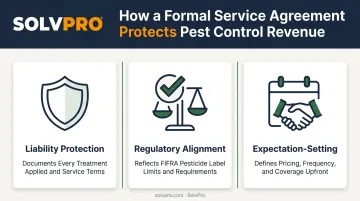
A formal agreement protects that revenue in three concrete ways:
- Liability protection. It documents what treatments were applied, where, and under what terms, which matters if a dispute ever escalates.
- Regulatory alignment. Pesticide labels carry legal weight under FIFRA, so your agreement must reflect those label-based limits, not contradict them.
- Expectation-setting. You define pricing, frequency, and coverage upfront, so neither side is guessing later.
Without a written agreement, you're relying on memory and goodwill to resolve disagreements. Neither holds up well when a customer calls three months in, insisting the technician promised "unlimited" pest coverage that was never actually part of the deal.
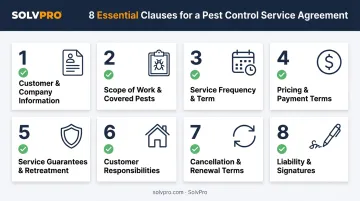
The Essential Clauses Every Pest Control Service Agreement Must Include
This is the checklist. These are the specific clauses that separate a professional, enforceable agreement from a fill-in-the-blank template you downloaded five minutes before a job.
Customer and Company Information
Include full legal names, phone numbers, email addresses, and the service address for both parties. Note who signed on behalf of the customer (homeowner, tenant, property manager) and who signed for the company. This sounds basic, but it's the detail that eliminates "who actually agreed to this" disputes later.
Scope of Work and Covered Pests
Name the specific pests covered under the agreement, whether that's ants, roaches, spiders, or rodents. State the treatment methods and the areas included, interior, exterior, or both. Then explicitly call out exclusions.
Termites and wildlife are the two most common gaps. If they're not covered, say so in plain language, not in a footnote.
Service Frequency and Agreement Term
State whether service runs monthly, bi-monthly, quarterly, or annually. Include the start date and the total length of the agreement. A customer should be able to glance at this section and know exactly when their next visit is scheduled and when the contract itself expires.
Pricing, Billing, and Payment Terms
Spell out the total cost, how often billing occurs, and which payment methods you accept. Include late-payment penalties if you charge them. Billing disputes almost always trace back to vague pricing language, so this section deserves plain, direct wording rather than legalese.
Service Guarantees and Retreatment Policy
If you offer a re-treatment guarantee, define exactly what triggers it. Which pests are covered? What counts as "pests returning" versus a new infestation? Without those boundaries, customers may reasonably assume the guarantee covers everything, which sets you up for a dispute you can't win.
Customer Responsibilities
Liability shouldn't sit entirely on the business. Document what the customer needs to do:
- Remove pets from treatment areas before service
- Provide access to interior and exterior treatment zones
- Complete any pre-treatment prep, such as clearing kitchen counters
Cancellation, Renewal, and Early-Termination Terms
Many pest control companies use an "initial-plus-recurring" pricing model, where the first visit is discounted because the real profit comes from the recurring visits that follow. An early-cancellation fee often exists to recapture that upfront discount if a customer cancels before those recurring visits happen.
Orkin, for example, doesn't charge a flat cancellation fee. Ending service before the initial term expires, though, may require paying the remaining contract balance.
Beyond that, your agreement needs to clearly state auto-renewal terms and required notice periods. This isn't optional in every state.
California's Automatic Renewal Law requires clear terms, affirmative consent before charging, and a cancellation method that matches how the customer signed up. If a customer enrolled online, they must be able to cancel online too, and New York and Illinois have similar consumer-protection statutes governing auto-renewal contracts.
Liability, Compliance, and Signatures
Close the agreement with a basic liability disclaimer aligned with local law, plus signature lines that include dates and roles for both parties.
Georgia takes this further than most states: Rule 620-7-.02 requires a signed household-pest-control contract on every job before treatment begins, and operators must retain it for two years after the contract expires. Even where it's not legally mandatory, this closing section is what makes the entire document enforceable.
Optional Clauses That Strengthen Trust and Reduce Disputes
Beyond the essentials, a few optional clauses go a long way toward building trust and heading off disputes before they start.
- Digital communication consent. Get explicit opt-in before texting appointment reminders or service reports—this protects you from consent complaints and confirms customers aren't added to a marketing list without permission.
- Auto-renewal disclosure as a standalone clause. Call out renewal terms in a distinct, bolded section, even if you mention them elsewhere, so customers can't later claim they were "surprised" by continued billing.
- Online review and acceptance. Letting customers review and sign the agreement digitally before the first visit sets a professional tone and creates a timestamped record of what they agreed to. Field service platforms like SolvPro build this into their digital contracts feature, making acceptance instant and paperless.
None of these are legally required in most states, but they consistently reduce the "I didn't know" conversations that eat up office staff time.
Common Mistakes That Make Pest Control Agreements Weak or Unenforceable
Even companies with a written agreement can undermine it with a handful of avoidable mistakes.
- Burying fees in fine print. If a fee matters, put it in normal-sized text, not a footnote. Courts generally side against the drafting party when language is ambiguous, since the company wrote the contract, not the customer.
- Skipping the "what happens if pests return" clause. This single omission drives a disproportionate share of customer disputes and negative reviews.
- Using one template for residential and commercial accounts. Commercial contracts typically need site-specific terms, multiple contact points, and longer durations. A residential template applied to a commercial account leaves gaps neither side notices until there's a problem.
- Ignoring legal review of state-specific rules. Pesticide disclosure and consumer-renewal laws vary by state: Texas requires posted notice before treatment, and Michigan requires risk-benefit information before the first application. Assuming your template covers every state is a compliance risk.
- Writing one-sided agreements. If the contract only protects your business with no customer responsibilities section, it erodes trust and holds up worse in a dispute.
Managing and Storing Agreements as You Scale
A single filing cabinet works fine for ten customers. It falls apart at a hundred. As your recurring accounts grow, paper contracts and scattered digital files create the exact problem a service agreement is supposed to prevent: missed renewals and lapsed accounts nobody notices until revenue drops.
Digital agreements are the expectation now. Customers want to review and sign electronically, and your office staff needs those signed documents connected to the customer's job history without digging through email threads or shared drives.
This is where a platform like SolvPro fits into a pest control operator's workflow. SolvPro isn't built specifically for pest control compliance tracking, chemical logs, or licensing—that still requires a dedicated tool. But for the operational side of running recurring accounts, it covers real ground:
- Digital contracts and e-signatures let you send a proposal, collect a signature, and convert it directly into a scheduled job without re-entering data
- Recurring job scheduling automatically populates future visits on a monthly, quarterly, or custom cycle
- Mobile invoicing generates bills the moment a technician finishes a job, rather than days later
- QuickBooks Online sync, included on every plan, keeps job costs and payments reconciled without manual double entry
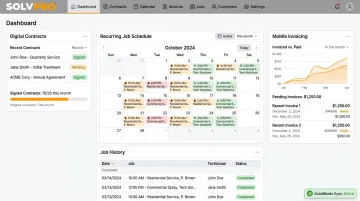
For a growing pest control company, the real goal is keeping that agreement connected to the schedule, the invoice, and the customer record. That connection keeps accounts from slipping through the cracks as your list grows.
Frequently Asked Questions
How do you write a pest control contract?
Define the scope of work, covered pests, and service frequency. Outline pricing, billing terms, exclusions, and guarantees, then close with renewal terms, cancellation terms, and signature lines for both parties.
What is the best pest control software?
It depends on your priority. Pest-specific platforms handle chemical logs and regulatory compliance, while a broader field service tool like SolvPro focuses on scheduling, digital contracts, invoicing, and payment processing for growing accounts.
What is a software as a service agreement?
A SaaS agreement governs the terms of using a software subscription, such as billing, uptime, and data handling. It's unrelated to a pest control service agreement, which governs recurring pest treatments between a company and a customer.
Is a pest control contract legally required?
Requirements vary by state. Georgia mandates a signed household-pest contract on every job, while Michigan permits oral agreements. A written contract is strongly recommended everywhere for compliance and dispute protection.
Can a customer cancel a pest control contract early?
Usually, yes, but it should be governed by clear terms. Most agreements require advance notice and may include an early-cancellation fee tied to a discounted first visit.
Do residential and commercial customers need different agreements?
Yes. Commercial accounts typically require site-specific terms, longer durations, and multiple contact points, while residential agreements are generally simpler and sold directly to the homeowner.