Introduction
Your scheduling app. Your cloud invoicing tool. Your payment processor. Every one of these runs on a contract for digital content or digital services, whether you've ever read the fine print or not.
Most business owners sign these agreements without a second thought. That's a problem. Vague cancellation terms, unclear data ownership, and silent auto-renewals can lock a service business into a tool that stops working for them.
The EU's Digital Content Directive offers the clearest legal blueprint for a fair contract, even though it doesn't apply directly to US companies.
Many of its core principles, such as clear cancellation rights and defined data ownership, already echo through US consumer protection law and FTC guidance.
This guide breaks down what these contracts cover, the principles regulators expect providers to follow, and a practical checklist for your next SaaS agreement.
Key Takeaways
- Digital content/service contracts cover software, apps, and cloud platforms paid for with money or personal data
- Fair contracts guarantee "conformity": the tool must work as described, stay updated, and remain secure
- Prioritize clear cancellation terms, data export rights, and transparent pricing before signing anything
- SolvPro's no-long-term-contract, transparent-pricing model mirrors these same consumer-protection principles
What Is a Contract for Digital Content & Digital Services?
A contract for digital content or digital services is an agreement where a provider gives you software, an app, or an online platform, and you pay for it with money, your personal data, or both. That's it. If you've clicked "I agree" on a SaaS platform, you've signed one.
The EU's Digital Content Directive offers the most detailed legal framework for how these agreements should work, and it draws a useful distinction most US contracts blur:
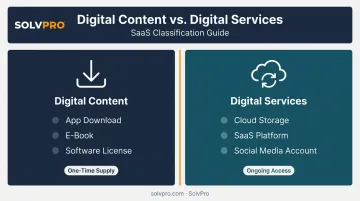
- Digital content: a file or program supplied once, such as an app download, an e-book, or a software license
- Digital services: ongoing access to something, such as cloud storage, a SaaS platform, or a social media account
Where "Goods with Digital Elements" Fit In
There's a third category worth knowing: goods with digital elements. Think smart thermostats, GPS trackers, or any physical equipment that can't function without a companion app. If your crew relies on connected hardware, you're also buying into a separate service agreement tied to it.
Does This Matter If You're Not in the EU?
The directive doesn't bind American businesses directly. But the logic behind it echoes in US law through the FTC Act, the Restore Online Shoppers' Confidence Act, and state consumer statutes like California's automatic-renewal law. The names differ, but the underlying expectations remain the same.
Subscribing to a field service platform like SolvPro is a real-world example. That signup is governed by a terms-of-service agreement that functions exactly like the contracts described above, covering what you get, what you pay, and what happens if either side doesn't hold up their end.
Key Legal Principles Every Contract Should Address
Before signing anything, check the contract against five principles that show up across both EU regulation and US enforcement actions.
Conformity. The software has to match its advertised description, quality, and functionality. If a vendor's marketing page promises real-time syncing and the contract is silent on it, that gap is where problems start.
Continuous supply obligations. For subscriptions, conformity isn't a one-time checkbox. Providers are expected to maintain it throughout the term, including delivering security patches and necessary updates without extra charge.
Provider liability for failures. When a service doesn't work as promised, a fair contract should spell out remedies:
- Fix the issue within a reasonable time
- Reduce the price if the fix doesn't fully resolve it
- Terminate the contract and get reimbursed if the issue is serious enough
Termination and data retrieval rights. You should be able to pull your customer records, job history, and invoices out of a platform within a reasonable window after canceling, in a format you can actually use.
Personal data as payment. Plenty of "free" digital tools aren't free. You're paying with data. Know what's collected, how it's used, and what happens to it after you leave before you sign.
None of this is theoretical. Regulators have gone after providers for exactly these failures. The FTC's case against Adobe alleged the company obscured an early-termination fee equal to 50% of remaining payments and made cancellation deliberately difficult. The result was a $150 million settlement announced by the Department of Justice.
Essential Clauses to Look for Before You Sign
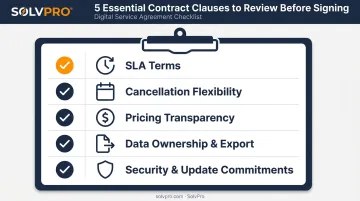
Read past the pricing page. These five clauses tell you what you're really agreeing to.
- Service Level Agreement (SLA) terms: uptime guarantees and defined support response times, not vague promises of "reliable service"
- Cancellation flexibility: month-to-month terms beat long-term lock-ins, especially for a growing business that might outgrow a tool in a year
- Pricing transparency: a line-item breakdown with no hidden fees, mandatory add-ons, or surprise charges once you're past onboarding
- Data ownership and export rights: confirmation that you can pull your business data out anytime, in a usable, machine-readable format
- Security and update commitments: clear language on who handles patches, breach notifications, and ongoing maintenance
A quick way to stress-test any contract: ask what happens on day one after you cancel. If the answer isn't in the document, that's your red flag. SolvPro, for example, sticks to month-to-month terms with no long-term lock-in, proof that transparent cancellation policies are standard practice for vendors who stand behind their product.
Common Pitfalls & Red Flags in Digital Service Agreements
Some contract language exists specifically to make leaving harder than joining. Watch for these patterns:
- Auto-renewal clauses buried in fine print: Contracts often renew automatically within a narrow cancellation window, with no advance reminder. The FTC's action against Vonage resulted in $100 million in refunds after regulators found the company routed customers through retention agents and kept billing after cancellation requests.
- Vague conformity language: If a contract avoids specifics about uptime, bug fixes, or feature availability, the provider has more room to dodge accountability when things break.
- Data lock-in: When export formats aren't defined, or exporting costs extra, switching providers becomes expensive and slow. The EU's Data Act now requires cloud providers to meet minimum switching and interoperability standards, showing how seriously regulators take this issue.
Before signing anything, ask directly: what format will my data be in if I leave, and is there a deadline for getting it?
How SolvPro Delivers a Fair, Transparent Digital Services Contract
People who've run field crews, not just coded software, built SolvPro, and that experience shows in how the agreement is structured.
- No long-term contracts. Cancel anytime. There's no annual lock-in disguised as a monthly price, and no early-termination fee waiting to surprise you.
- Transparent, SMB-friendly pricing. Starter and Growth tiers run $179 to $228/month and include QuickBooks Online sync and NMI processing, with no add-on fees for core tools.
- Real onboarding support. A live team walks you through setup, typically in under 10 minutes, rather than pointing you to a help article.
- Bilingual documentation. English and Spanish support across the platform ensures office staff and field crews understand what they're agreeing to, not just what they're clicking through.
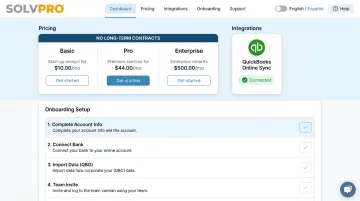
That combination reflects the same principles regulators have spent years pushing providers toward: clear terms, fair exit paths, and no charging customers for features they were told were included.
Frequently Asked Questions
What is a contract for the supply of digital content and digital services?
It's an agreement where a business supplies software, apps, or online platforms to a customer in exchange for payment or personal data. These agreements typically include quality standards and remedies, like a fix or refund, if the service doesn't perform as promised.
What's the difference between digital content and a digital service?
Digital content is something supplied once, like a downloaded app or a file. A digital service is ongoing access, like cloud storage or a SaaS platform you log into repeatedly.
Do US businesses need to worry about EU digital content laws?
The EU directive doesn't legally apply to US companies. However, its consumer-protection principles, like clear cancellation terms and data export rights, mirror what American SMBs should expect from any software vendor.
What happens if a digital service doesn't work as promised?
The provider should fix the issue within a reasonable time. If that fails, you're entitled to a price reduction or the right to terminate the contract with reimbursement.
Can I cancel a digital services contract anytime?
It depends on the provider. Some lock you into annual terms with early-termination fees, while others, like SolvPro, allow cancellation anytime without long-term commitment.
What should I check before signing a SaaS contract for my business?
Focus on four things: pricing transparency, data ownership and export rights, SLA terms covering uptime and support, and cancellation flexibility. If any of these are vague, ask before you sign, not after.