Get it wrong, and the stakes are real. Misclassifying a worker or skipping a required W-8BEN can trigger IRS penalties, backup withholding, or a 30% withholding bill that lands on your business, not the contractor.
This guide breaks down the exact forms, thresholds, and deadlines for both US-based and foreign contractors, so you can stay compliant without calling a tax attorney every time you make a hire.
Key Takeaways
- US contractors need a signed W-9, plus a 1099-NEC once pay hits the reporting threshold
- Non-US contractor tax status depends on where work is performed, not nationality
- US-sourced income paid to foreign contractors can trigger 30% withholding and Form 1042-S reporting
- Tax treaties can reduce or eliminate withholding, but contractors must claim the benefit
- Signed forms, timesheets, and location records are your best defense against IRS scrutiny
US Contractor Tax Rules: What Every Business Owner Needs to Know
The IRS requires a Form 1099-NEC when four conditions are all true:
- The payment went to someone who is not your employee
- It was for services performed in your trade or business
- The recipient is an individual, partnership, estate, or (in some cases) a corporation
- Total payments to that person for the year meet the reporting threshold
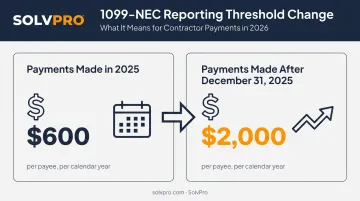
That last point has changed recently. The $600 threshold applied through payments made in 2025.
For payments made after December 31, 2025, the threshold jumps to $2,000 per payee, per calendar year, according to the IRS's current Form 1099-NEC guidance. One exception: if you withheld any federal tax under backup withholding rules, you must file a 1099-NEC regardless of the amount.
Collect the W-9 First, Not Later
Get a completed Form W-9 before you send the first payment. It captures the contractor's Taxpayer ID or SSN and confirms their US tax status. Waiting until January, when you're scrambling to file 1099s, is how businesses end up with missing TINs and no way to reach a contractor who's since disappeared.
Filing Deadlines and Backup Withholding
- January 31 — deadline to furnish 1099-NEC copies to contractors and file with the IRS
- Form 1096 — used only to transmit paper filings; not needed for e-filed returns
- E-filing mandatory — if you issue 10 or more information returns total (combining all types, including W-2s), you must file electronically
If a contractor won't provide a TIN, or the IRS flags one as incorrect, you may be required to withhold 24% backup withholding from future payments and remit it to the IRS. Once triggered, this becomes a mandatory duty you carry as the payer.
Don't Skip the Classification Question
Before any of this matters, you need to confirm the person is actually a contractor. The IRS looks at three areas: behavioral control, financial control, and the type of relationship. No single factor decides it; the IRS weighs the whole picture. Misclassify an employee as a contractor, and you can be liable for the resulting employment taxes.
Non-US Contractor Tax Rules: What Every Business Owner Needs to Know
Here's the rule that trips up most business owners: a foreign contractor's income is taxable in the US only if the work is physically performed within the US. Currency, invoice address, and where the client sits don't matter.
Four Scenarios You'll Actually Run Into
- Work performed entirely outside the US: generally not US-sourced, no US tax obligation
- US client work, paid through a foreign entity: still typically not US-sourced if the labor happens abroad
- Nonresident alien working inside the US, under substantial presence thresholds: taxed only on US-sourced income
- Nonresident alien who crosses those thresholds: now taxed like a US resident, on worldwide income
W-8BEN and W-8BEN-E: What They Actually Do
Use Form W-8BEN for foreign individuals and Form W-8BEN-E for foreign business entities. Both establish foreign status and, when applicable, let the contractor claim treaty benefits. Neither form goes to the IRS — you keep them on file.
They're valid from the signing date through December 31 of the third following calendar year. A W-8BEN that expires without renewal can retroactively expose your business to withholding liability you didn't know you had.
The 30% Withholding Rule
If a foreign contractor's income is US-sourced, US-source compensation for independent personal services is generally subject to 30% NRA withholding under IRC Section 1441, according to IRS Publication 515. This applies regardless of the $600 or $2,000 threshold used for domestic contractors, meaning even a single US-sourced payment can trigger it.
Reporting: Form 1042 and 1042-S
- Form 1042 — your annual withholding return
- Form 1042-S — recipient-specific reporting, required even if the withholding rate drops to 0% under a treaty
- Deadline: March 15 applies to both filing and furnishing to the recipient, notably earlier than the 1099-NEC deadline
Tax Treaties Can Change the Math
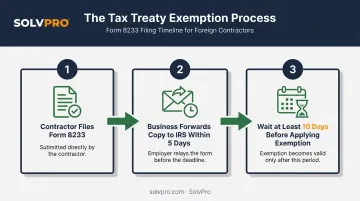
US tax treaties can reduce or eliminate withholding on personal services income, but the contractor has to actively claim it. For compensation covered by a treaty, that generally means filing Form 8233, not just a W-8BEN. You then forward a copy to the IRS within five days and typically wait at least ten days before applying the exemption.
US vs. Non-US Contractors: Key Differences at a Glance
The single factor that determines a non-US contractor's tax treatment is where the work happens — not their citizenship, and not where they're paid from.
| Factor | US Contractor | Non-US Contractor |
|---|---|---|
| Collection form | W-9 | W-8BEN (individual) or W-8BEN-E (entity) |
| Reporting form | 1099-NEC | 1042-S |
| Reporting threshold | $600 (2025) / $2,000 (2026+) | No threshold for US-sourced income |
| Default withholding | None (with valid W-9) | 30%, unless reduced by treaty |
| Filing deadline | January 31 | March 15 |
| Paper transmittal | Form 1096 | Form 1042-T |
Both paths share one requirement: it's your job, not the contractor's, to request the correct form before the first payment. And both require you to keep records, including signed forms, payment history, and supporting documentation, for at least three to four years.
Common Contractor Tax Compliance Mistakes to Avoid
A few mistakes show up again and again in audits and IRS inquiries:
- Paying before collecting the right form. No W-9 or W-8BEN on file before the first payment leaves you exposed if the IRS later questions the relationship.
- Assuming nationality decides taxability. A Canadian contractor working remotely from Toronto isn't US-sourced income, but one flying to your job site in Texas is. Location, not citizenship, determines taxability.
- Letting a W-8BEN expire. Past its three-year validity window, an expired form can retroactively expose you to withholding liability you didn't budget for.
- Underestimating enforcement risk. Misclassifying an employee as a contractor can make your business liable for federal taxes. The IRS's Voluntary Classification Settlement Program exists for businesses that want to fix errors before enforcement catches them.
Penalties for missed or incorrect information returns aren't trivial either. According to the IRS's information return penalty schedule, for returns due in 2026, penalties run $60 per return if corrected within 30 days, up to $340 per return if filed late or not at all.
Intentional disregard carries a penalty of $680 per return or 10% of the reportable amount, whichever is greater, with no cap.
Staying Organized When You Manage a Mix of US and International Crews
Once you're juggling a handful of subcontractors, crews, and remote specialists across borders, the paperwork gets messy fast. Who's been paid? Which forms are actually on file? And, critically for tax sourcing, where was the work physically done?
This is where good operational habits matter as much as good tax knowledge. SolvPro's job tracking captures this data automatically, so you're not reconstructing it from memory later:
- Event-based geolocation stamps every check-in and work order update with a location
- Geo-stamped time entries record exactly when and where each job started and finished
- Photo uploads and activity logs create a timestamped record of completed work
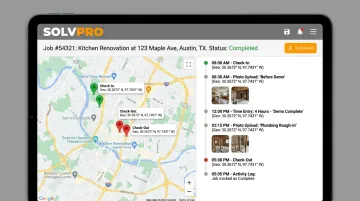
This isn't a substitute for tax or legal advice. But it does give you an operational safeguard: a documented trail showing when and where a contractor's work actually happened, which is exactly the kind of record you'd want if the IRS ever questioned a sourcing determination.
Good documentation only helps if the underlying paperwork is accurate, and that starts with clear communication during onboarding. For businesses coordinating with Spanish-speaking subcontractors or crews, SolvPro's bilingual English/Spanish interface helps cut down on miscommunication when forms are being explained and paperwork is being collected.
Frequently Asked Questions
What is the US tax software for non-residents?
Non-resident tax software helps individuals living abroad file personal US returns. It covers the contractor's side, not the employer-side W-8BEN and 1042-S compliance discussed in this guide, so consult a tax professional for cross-border filings.
Are US companies required to send 1099s to contractors working remotely outside the US?
No. Contractors performing work entirely outside the US typically don't receive a 1099-NEC. Collect a Form W-8BEN instead, and if the income isn't US-sourced, no US reporting form is usually required.
Do I need a W-9 or a W-8BEN from my contractor?
A W-9 applies to US citizens and residents; a W-8BEN (or W-8BEN-E for entities) applies to non-US persons. The determining factor is tax residency status, not where they're physically located.
What happens if I don't withhold taxes for a foreign contractor who worked in the US?
Your business can become liable for the unpaid 30% withholding, plus penalties and interest. The IRS holds the US payer responsible for NRA withholding compliance, not just the contractor.
Is there a minimum payment threshold before I need to report contractor payments?
For US contractors, the 1099-NEC threshold applies. For non-US contractors with US-sourced income, reporting and withholding obligations can apply regardless of the amount paid.
Can a tax treaty eliminate withholding for a foreign contractor?
Yes, many US tax treaties reduce or eliminate withholding on personal services income. The contractor must claim the benefit, typically through Form 8233, before your business can apply the reduced rate.