That's the "profitable but broke" trap, and it catches multi-crew service businesses more often than owners like to admit. SCORE has pointed to cash flow problems as the reason most small businesses fail, a figure that's been widely repeated across the small business community even if the underlying research trail is murky.
Here's the distinction that matters: profit tracking tells you what you earned. Cash flow analysis tells you when that money actually lands in your account. This guide breaks down how to analyze cash flow specifically for field service operations, step by step.
KEY TAKEAWAYS
- Cash flow analysis tracks timing of money in vs. out, not just profit on paper
- Delayed invoicing, slow-paying customers, and underpriced jobs create unique cash flow risks
- A repeatable 6-step process turns raw job and payment data into clear decisions
- SolvPro automates the data-gathering steps that used to eat up hours
- Cash gaps come from timing, so the invoicing date matters as much as the invoice amount
What Is Cash Flow Analysis in Field Service Management?
Cash flow analysis, in a field service context, means examining the actual movement of cash tied to your jobs, invoices, payroll, materials, and overhead over a set period. What matters isn't whether a job was profitable on paper, but whether the cash it generated actually landed in the bank when you needed it.
Field service owners typically run this kind of analysis for a handful of specific purposes:
- Accounts receivable follow-up: Chasing down invoices before they age too far
- Job costing and profitability review: Checking whether specific jobs or job types are draining cash
- Seasonal planning: Preparing for slow months when work dries up but bills don't
- Crew payroll forecasting: Making sure payroll clears even when collections lag
There are two lenses you'll use here. Historical cash flow looks backward, pulling from your bank and accounting records to show what actually happened last month or last quarter.
Forecasted cash flow looks forward instead, using scheduled jobs, open invoices, and recurring costs to project what's coming. Most field service businesses need both: history shows you patterns, and forecasts help you avoid getting blindsided.
Why Analyzing Cash Flow Is Critical for Field Service Businesses
Retail businesses collect payment the moment a sale happens. Field service doesn't work that way. Your income arrives in uneven chunks tied to job completion, invoice timing, and how quickly a customer decides to pay. That irregularity is exactly why cash flow analysis matters so much in this industry.
Without a regular review habit, most businesses only discover a cash shortage once it's already a problem, when payroll is due and the account is thin. By then, your options are limited to a credit line, a delayed vendor payment, or an uncomfortable conversation.
Running consistent cash flow analysis instead gives you:
- Collections clarity: you see exactly which customers or job types are slow to pay, so you know where to focus follow-up
- Early warning on underpriced jobs: margin problems get flagged before they drain your reserves
- Better payroll and purchasing timing: you can forecast upcoming gaps instead of reacting to them
- Smarter growth decisions: hiring, new trucks, or new equipment get evaluated against your real cash position, not guesswork
- Less dependence on credit: fewer scrambles to cover short-term gaps with borrowed money
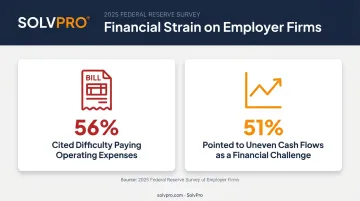
The scale of this problem is bigger than most owners realize. A 2025 Federal Reserve survey of over 7,600 U.S. employer firms found that 56% cited difficulty paying operating expenses. Another 51% pointed to uneven cash flows as a financial challenge. Field service businesses, with their project-based income patterns, sit squarely in that risk zone.
How to Analyze Cash Flow in Field Service Management: A Step-by-Step Framework
This is a practical routine a service business owner or office manager can run every month, no finance degree required.
The most common mistake? Waiting until there's already a problem. Cash flow analysis works best as a scheduled habit, not a fire drill.
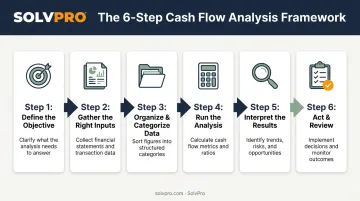
Step 1 – Define the Objective
Before pulling any numbers, get specific about what you're trying to answer. Are you chasing overdue invoices? Planning for a slow season? Evaluating whether a particular job type is worth taking on again?
Vague goals like "check on the money" lead to unfocused analysis and wasted time. A specific question, such as "Why is cash tight when we're fully booked?", drives a specific data pull.
Step 2 – Gather the Right Inputs
You'll need several data points pulled together:
- Outstanding invoices (accounts receivable)
- Upcoming bills (accounts payable)
- Payroll schedules and amounts
- Job costs (labor, materials, travel)
- Current bank balances
Most crews already have plenty of data. The problem is that it lives in five different places: a spreadsheet here, paper tickets there, a separate invoicing app somewhere else. That scatter slows everything down and introduces errors, and it's exactly the gap a platform like SolvPro closes by keeping scheduling, invoicing, and job costing in one system.
Step 3 – Organize & Categorize the Data
Once you have the numbers, group them by job, customer, crew, or service type. This is what turns raw numbers into patterns. Maybe one crew consistently runs over budget on materials. Maybe commercial cleaning jobs pay faster than residential landscaping contracts.
Consistent categorization matters because it's what lets you compare month over month. Without it, every analysis starts from scratch.
Step 4 – Run the Analysis
Now you calculate. Three core numbers matter most:
- Cash flow statement: total inflows minus total outflows for the period
- Days Sales Outstanding (DSO): how many days it takes on average to collect payment after invoicing, calculated as average accounts receivable divided by net credit sales, times the number of days in the period
- Job-level margin analysis: revenue minus job costs, as a percentage, for each job or job type
A rising DSO means cash is getting stuck in receivables longer. A shrinking job margin means costs are creeping up faster than pricing. Run both, and you'll see where cash is actually tied up.
Step 5 – Interpret the Results
Numbers alone don't fix anything: you need to read the red flags correctly. Watch for:
- Rising DSO: customers or job types taking longer to pay than they used to
- Shrinking margins on specific jobs or crews
- A widening gap between what's invoiced and what's actually collected
The key here is digging into root cause, not just symptoms. A slow-paying customer is a different problem than a slow invoicing process on your end. One means tightening collections; the other means fixing your own workflow.
Step 6 – Act & Review
Based on what you found, take action:
- Tighten payment terms for chronically slow payers
- Automate invoice reminders instead of relying on manual follow-up
- Adjust pricing on job types that consistently run thin margins
- Build a cash reserve ahead of predictable slow seasons
Then set a recurring cadence, monthly at minimum, to repeat the analysis and check whether your actions actually moved the numbers.
Real-World Example: Cash Flow Analysis in Action
Picture a multi-crew service business running four crews with a full job schedule. On paper, revenue looks solid. In reality, the owner is watching the bank balance shrink week over week and can't figure out why.
Following the framework:
- Objective: Why is cash tight despite a full pipeline?
- Data pull: AR aging report and job cost data across all four crews
- Finding: Invoices were going out 5 to 7 days after job completion, not the same day
The business had tracked profit per job carefully, and margins looked fine. What they'd never tracked was how long it took to actually collect payment after the invoice went out. That gap between finishing the work and getting paid was draining the checking account week after week.
The fix: same-day mobile invoicing from the job site, paired with automated payment reminders for anything unpaid past 15 days.
Within a couple of billing cycles, average collection time dropped noticeably, and the cash crunch eased even though job volume stayed the same. The core issue was the delay between finishing a job and collecting payment, not pricing or productivity.
How SolvPro Helps You Analyze and Improve Cash Flow
Steps 2 through 4 of the framework above — gathering data, organizing it, and running the numbers — are exactly where most field service businesses lose hours. SolvPro was built to remove that manual grind by keeping job, invoicing, and payment data centralized in one platform instead of scattered across spreadsheets and paper tickets.
A few specifics worth knowing:
- QuickBooks Online sync comes standard on every pricing tier, keeping your accounting records current without duplicate entry so you can trust your AR numbers during analysis.
- NMI payment processing and mobile invoicing let crews generate invoices and collect credit card or ACH payments right from the job site, shortening the invoice-to-payment gap.
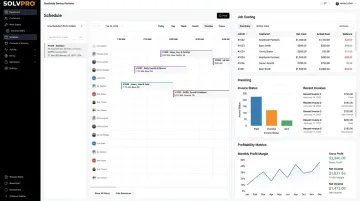
- Job costing and profitability visibility show labor, material, and job-level margins in real time, so an underpriced or over-budget job stands out immediately.
The platform comes from a team with 50+ years of combined experience in construction and field service, people who've felt the cash flow squeeze firsthand. That background shapes practical decisions: setup takes under 10 minutes, pricing stays transparent across the Starter, Growth, and Scale plans, and there's no long-term contract.
Consistent, software-backed cash flow analysis doesn't have to be a quarterly scramble. Run it monthly, act on what you find, and it becomes a habit that protects growth instead of reacting to a crisis.
Frequently Asked Questions
What Is the Software for Managing Cash Flow?
Cash flow management software tracks money moving in and out of a business, forecasts future cash positions, and often syncs with accounting tools like QuickBooks. Field service platforms like SolvPro build related features, including job costing, invoicing, and payment tracking, directly into the operational workflow.
What Is Cash Flow Analysis in Field Service Management?
It's the process of tracking and interpreting the timing of money in and out of a field service business, tied specifically to jobs, invoices, and payroll. The goal is understanding when cash actually arrives, not just what's owed on paper.
How Often Should Field Service Businesses Analyze Cash Flow?
Monthly at minimum, with weekly checks recommended for businesses running tight margins or scaling quickly. A fixed schedule beats reacting only when a shortage already hurts.
What Causes Cash Flow Problems in Field Service Businesses?
The most common causes are slow invoicing, underpriced jobs, seasonal demand swings, and customers who consistently pay late. Often it's a combination of two or three at once.
What's the Difference Between Cash Flow and Profit for a Service Business?
Profit is revenue minus expenses on paper for a given period. Cash flow reflects when that money actually lands in your bank account, which can lag well behind the profit shown on a job.
Can Field Service Management Software Really Improve Cash Flow?
Yes. By speeding up invoicing, enabling on-site payment collection, and centralizing job cost data, FSM software shortens the time between finishing a job and getting paid. This directly addresses the timing gap at the root of most cash flow problems.