Labor costs on a dig aren't one number. They swing based on the operator's skill level, your region, the equipment involved, and whether you're bidding public or private work. A prevailing-wage job in Arizona can run 20-35% above a comparable private job just on base wages.
This guide breaks down 2026 hourly rate ranges by role, the hidden costs that sit behind every wage figure, and a practical way to budget and track labor so your margin doesn't quietly disappear mid-job.
KEY TAKEAWAYS
- Billed labor rates run well above raw wages once taxes, insurance, and overhead are added
- Operator experience, equipment size, and region create the widest rate swings in excavation work
- Public projects with Davis-Bacon prevailing wage rules often cost 20%+ more than private-market labor
- Tracking field hours against your estimate catches labor overruns before they erode your margin
- Idle and mobilisation time still costs money, so hours that are paid but not billable belong in the rate calculation
How Much Do Excavating Contractor Labor Costs Run in 2026? (Pricing Overview)
Excavation labor doesn't have a single fixed rate. Costs shift depending on the worker's role, your local market, and the complexity of the dig. There's also a critical distinction most bid documents blur: the wage a crew member takes home versus the loaded rate a contractor bills the client. The loaded rate covers taxes, insurance, benefits, and overhead on top of the wage, and it's almost always the number that should show up on your invoice.
Based on the BLS Occupational Employment and Wage Statistics (2024), here's how raw hourly pay breaks down by role:
| Role | Hourly Wage Range | Median (2024) |
|---|---|---|
| General laborer | $15–$37 | $22.14 |
| Mini-excavator/skid-steer operator | $18–$46 | $28.04 |
| Standard excavator/backhoe operator | $18–$46 | $28.04 |
| Senior/specialized operator | $35–$46 | Proxy figure (no separate BLS category) |
| Foreman/supervisor | $24–$59 | $36.90 |
These are employee wages only, not billed rates. You'll add burden and margin on top, which we cover below.
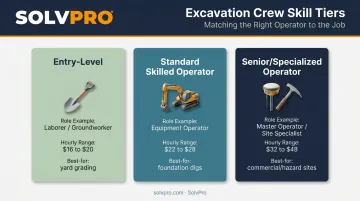
Entry-Level Labor
General laborers running basic hand tools, directing traffic, or supporting an operator fall into this tier. Supervision tends to be light, and the work usually involves simple grading, backfill, or site cleanup rather than technical cuts. This keeps costs low on lower-risk jobs.
Best for: smaller residential jobs, basic yard grading, or prep work ahead of a bigger crew arriving.
Standard Skilled Operator Labor
This is the workhorse tier for most excavation businesses. It covers certified operators running standard excavators or backhoes, typically under moderate supervision from a foreman. Site conditions can push wages toward the top of this range.
Best for: foundation digs, utility trenching, and general site prep — the bulk of day-to-day excavation revenue.
Senior/Specialized Operator Labor
Expect GPS machine control, rock hammer or blasting work, articulated haulers, and other large equipment in this tier, where a mistake carries real safety or cost consequences. Wages stay near the top of the range here.
Best for: commercial and industrial sites, or any job with high complexity and hazard exposure that justifies the premium.
Key Factors That Affect Excavating Contractor Labor Rates
Labor pricing depends on more than just the type of dig. Who's running the machine, where the job sits, and what the market is doing that week all shape the final rate.
Experience, Licensing & Skill Level
OSHA 10/30 courses and CDL endorsements for hauling equipment don't come with a published wage formula, but they consistently push pay above entry-level rates in practice. A CDL-holding operator who can also run as a competent person for trench inspections is worth more to you than one who can't, so plan your bid accordingly.
Equipment Complexity & Specialization
Running a GPS-guided excavator or a rock hammer attachment isn't the same job as a standard backhoe. These roles demand higher-paid, more experienced operators, and rock or blasting work typically carries a hazard-pay premium on top of the base rate.
Project Site Conditions & Location
Tight urban access, rocky or unstable soil, and remote sites all slow production and raise your effective labor cost per cubic yard, even at the same hourly rate. Coastal and major metro markets run far higher than rural ones. BLS data shows operator wages in San Francisco averaging more than double the rate in rural Kansas.
Union vs. Non-Union Labor & Prevailing Wage Requirements
Public and government-funded jobs generally require Davis-Bacon prevailing wages. A recent Davis-Bacon wage determination for heavy construction in Mohave County, Arizona set excavator operator pay at $54.76/hour including fringe, well above typical private-market rates for the same role. Union agreements also shape scheduling and crew structure, which affects your cost model.
Seasonal Demand & Overtime
Overtime kicks in past 40 hours a week under the Fair Labor Standards Act, at 1.5x the regular rate. Peak construction season pushes crews toward that overtime threshold more often, while winter slowdowns in colder regions can free up scheduling flexibility and lower costs.
What's Included in True Labor Cost (Beyond the Hourly Wage)
Contractors who price a job on the hourly wage alone consistently underbid it. The real cost of a crew member stacks several layers on top of base pay.
- Base wages (recurring): the direct hourly rate paid to the crew member for time on the job
- Payroll taxes (recurring): employer FICA runs 7.65% of wages, and net FUTA typically adds up to $42 per employee before state credit-reduction effects
- Workers' compensation (recurring): excavation is rated as high-risk. New York's excavation class code carries a loss cost of nearly $3.96 per $100 of payroll, well above office-based trades
- Benefits, PTO, and training (recurring/periodic): health coverage, paid time off, trench safety training, and PPE all add to the fully burdened number
- Overhead allocation and margin (variable): most contractors apply a labor burden multiplier over base wage, commonly between 1.4x and 2x, to land on the rate they actually bill
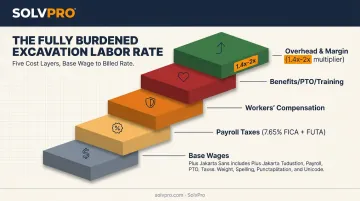
Skip any one of these and your "profitable" bid turns into a break-even job.
How to Calculate & Budget Labor Costs for Your Excavation Jobs
Accurate labor budgeting starts with a burdened rate, not a wage. Layer in realistic hour estimates, and you've got a number you can actually defend.
Many excavation contractors benchmark labor at roughly 30-40% of total job cost. That share shifts with how equipment-intensive the work is: a heavily mechanized job pushes more cost toward equipment, while a labor-heavy trench job pushes the percentage higher. Track your own job history over time to refine this for your business.
The basic formula:
Burdened hourly rate × estimated hours × crew size = total labor cost
Worked example: A 3-person crew at a blended burdened rate of $45/hour, working an estimated 40 hours on a trenching job:
$45 × 40 × 3 = $5,400 total labor cost for the job
That number only holds up if the crew actually works 40 hours. This is where most estimates fall apart: the office prices the job, the crew runs long, and nobody catches it until the invoice goes out weeks later.
Seeing the numbers while the job is open closes that gap. SolvPro's crew and job time tracking lets field crews log hours by job and by worker, using manual entries or live timers.
Office staff then see actual labor hours accumulating against the estimate as the job runs. Overruns get flagged while there's still time to issue a change order, rather than after the job closes and the margin is already gone.
Common Mistakes That Erode Excavation Labor Profitability
A handful of recurring errors quietly drain margin on excavation jobs:
- Pricing off base wage alone: Skipping payroll taxes, workers' comp, and overhead in the bid leads to an underbid job before the first shovel hits dirt.
- Not tracking actual hours against the estimate: Overruns often go unnoticed until the job closes out unprofitable.
- Skipping travel, mobilization, and idle-time billing leaves crews paid for downtime or transit that never makes it onto an invoice.
- Overlooking prevailing wage or union requirements can turn a public job bid at private-market rates into a painful correction once Davis-Bacon compliance kicks in.
Catching these requires the same fix every time: know your real cost per hour, and track hours as they happen rather than reconstructing them after the fact. Field service platforms with built-in job costing, like SolvPro, make that real-time tracking possible without adding paperwork for the crew.

Conclusion
Your crews are busy. So why isn't there more money in the bank?
When the office can see labor, materials and documented changes against the job while the work is still open, the numbers at the end stop being a surprise. SolvPro keeps scheduling, work orders, time, job costing and invoicing on one record. When you want to see it on your kind of work, Book a Demo.
Run the Job. Protect the Profit.
Frequently Asked Questions
How Do Excavating Contractors Calculate Labor Costs?
Contractors multiply a fully burdened hourly rate (wage plus taxes, insurance, and overhead) by estimated hours and crew size, then add margin to reach the billed labor cost for the job.
What Is a Good Percentage for Labor Cost?
Labor typically runs 30-40% of total excavation job cost, though equipment-heavy jobs skew lower and labor-intensive trenching work skews higher. Track your own job data to refine this number over time.
How Do You Calculate Excavation Costs?
Total excavation cost combines labor, equipment, materials or disposal, and overhead, usually estimated per cubic yard or per hour. Labor is typically the largest and most variable piece of that total.
What Is the Average Hourly Rate for an Excavator Operator in 2026?
Standard excavator operators typically earn $18-$46 per hour in wages, with a national median around $28. Rates vary by experience, equipment size, and regional market.
What's Included in a "Burdened" Labor Rate?
A burdened rate includes base wage plus payroll taxes, workers' compensation, benefits, training costs, and overhead, not just the take-home pay a worker receives.
Do Union or Prevailing Wage Requirements Affect Excavation Labor Costs?
Yes. Public and government-funded projects often require Davis-Bacon prevailing wages, which can run 20% or more above private-market non-union rates for the same equipment classification.