Many facility managers and cleaning business owners struggle with the same problem. Tasks get done when someone remembers, not on a set rhythm. Shifts overlap, quality drifts, and small maintenance issues turn into expensive repairs.
A structured cleaning schedule fixes this by assigning every task a specific frequency, owner, and location. This guide breaks down exactly which tasks belong daily, weekly, and monthly, plus how to build a schedule your crews will actually follow.
KEY TAKEAWAYS
- Every task gets a set frequency, so nothing is missed or duplicated
- Daily tasks target high-touch surfaces; weekly and monthly tasks protect long-term flooring and air quality
- Facility type and foot traffic should shape your frequencies, not a one-size-fits-all template
- Tracking completion across crews matters as much as the checklist itself
- A written schedule also settles disputes with a client, because it records what was agreed rather than what was assumed
Why a Commercial Cleaning Schedule Matters
A written schedule keeps quality consistent across shifts, crews, and supervisors. Without one, the person cleaning Tuesday's night shift may skip tasks the Monday crew always covers, and nobody notices until a client does.
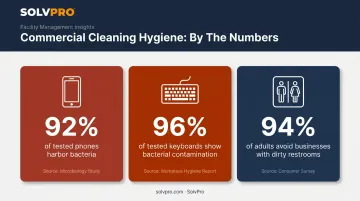
Health and hygiene risks: A peer-reviewed study testing shared office equipment found bacteria on 92% of tested mobile phones and 96% of tested computer keyboards, with keyboards showing contamination from enteric bacteria on nearly two-thirds of samples.
The sample was small and specialized, but it makes a clear case for routinely disinfecting shared devices and desks rather than cleaning them "when someone remembers."
Workplace hygiene programs also show measurable benefits for illness-related absence, though the research is nuanced. A large workplace trial found hygiene-preventable health claims dropped over 20% in participating offices, though the absence reduction compared to a control group wasn't statistically significant on its own.
The takeaway: cleaning is one piece of a broader hygiene strategy, not a silver bullet by itself.
First impressions: A dirty restroom can cost you clients. According to ISSA's Value of Clean research, citing a Harris Interactive survey commissioned by Cintas, 94% of adults say they'd avoid a business after encountering a dirty restroom. That single data point should justify daily restroom checks on its own.
Cost control matters too. Preventive, scheduled cleaning:
- Extends carpet and hard-floor life by catching soil before it becomes embedded
- Avoids emergency stripping or extraction jobs that cost far more than routine maintenance
- Reduces the risk of losing a contract over a complaint that a schedule would have prevented
Types of Commercial Cleaning Tasks
Not every cleaning task deserves the same frequency. Tasks generally fall into three tiers based on depth, equipment needed, and how quickly neglect becomes visible.
Routine Janitorial Cleaning
This is your daily upkeep layer: trash removal, disinfecting high-touch surfaces, restroom sanitation, sweeping, and mopping. It's the baseline that keeps a facility functional and presentable day to day.
Periodic Deep Cleaning
Weekly and monthly tasks prevent the buildup that routine cleaning can't catch. Think carpet extraction, floor scrubbing, and upholstery care. These tasks require more time, sometimes specialized equipment, and are scheduled during slower hours to avoid disrupting operations.
Specialized or Compliance-Driven Cleaning
Some tasks are required by code or industry standard, not optional extras. Commercial kitchen exhaust systems, for example, fall under NFPA 96, which sets inspection intervals ranging from monthly for solid-fuel cooking to annually for low-volume operations. Cleaning itself is triggered when an inspection finds grease contamination, not on a fixed calendar.
Other examples include:
- Exterior window cleaning
- Pressure washing of building exteriors
- Grout restoration
These services are typically quarterly or annual add-ons layered onto the base schedule.
Commercial Cleaning Schedule: Daily, Weekly & Monthly Tasks
Every facility is different, but this breakdown covers the baseline tasks most commercial spaces should follow at each frequency.
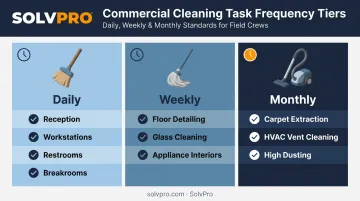
Daily Cleaning Tasks
Daily tasks target the areas that accumulate dirt and germs fastest:
- Reception and entryways: Remove trash, disinfect door handles and high-touch points, vacuum entry mats, spot-clean floors
- Workstations and offices: Empty bins, disinfect shared phones and keyboards, sanitize light switches and desk surfaces
- Restrooms: Disinfect toilets and sinks, restock paper products and soap, mop floors
- Breakrooms and kitchens: Sanitize counters and appliance exteriors, empty trash, clean sinks
These tasks focus on visible cleanliness and shared surfaces, exactly the areas the CDC's facility guidance flags for regular attention in high-traffic zones.
Weekly Cleaning Tasks
Weekly tasks catch what daily cleaning can't cover in a short window. They're typically scheduled for slower business hours to avoid disrupting staff:
- Detailed floor care, including edge vacuuming, baseboard dusting, and stairwell mopping
- Interior glass and partition cleaning
- Appliance interiors: microwave, fridge, coffee maker
- Restroom detail work: grout scrubbing, fixture polishing, trash receptacle disinfection
Monthly Cleaning Tasks
Monthly tasks protect long-term assets and air quality:
- Carpet extraction and hard-floor machine scrubbing, following IICRC S100 guidelines
- High dusting, HVAC vent cleaning, ceiling fan wipe-downs, and upholstery vacuuming
- Interior window detailing, supply audits, and equipment inspections
The IICRC S100 standard, the industry benchmark for professional carpet care, recommends professional cleaning at least annually for regularly used carpet, with high-traffic areas needing extraction more often.
Facilities with heavier demands (restaurants, medical offices, industrial sites) often layer quarterly or annual services on top, including exterior window cleaning, pressure washing, and grout restoration.
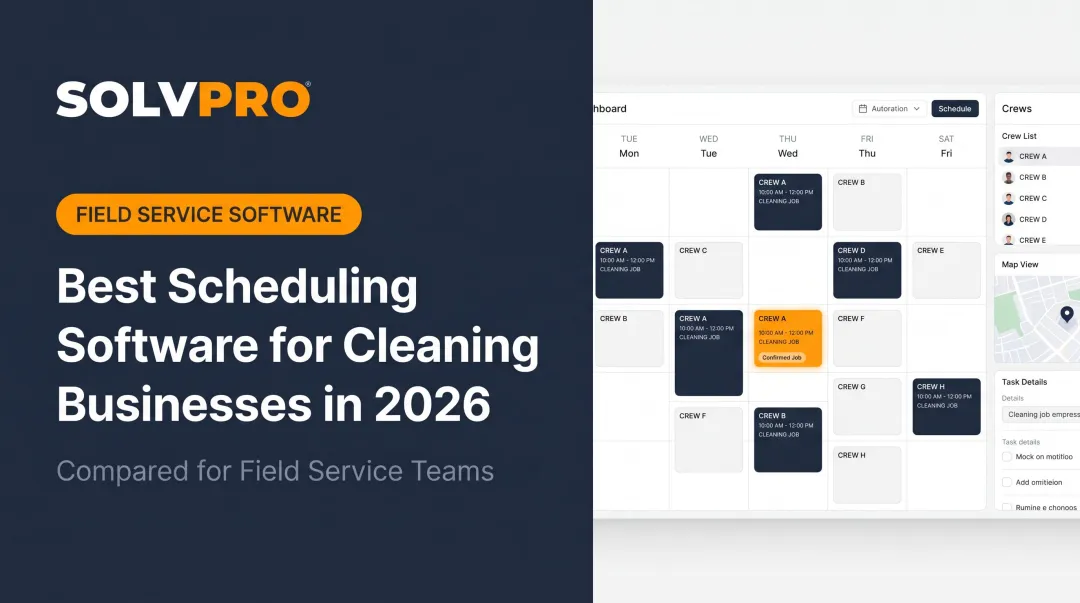
Keeping every task on schedule gets easier with software built for crews in the field. Platforms like SolvPro handle recurring job scheduling and checklists, so daily, weekly, and monthly tasks stay visible across your whole team.
How to Build and Manage a Cleaning Schedule That Actually Works
A checklist alone doesn't guarantee results. Building a schedule that holds up under real operating conditions takes a few deliberate steps.
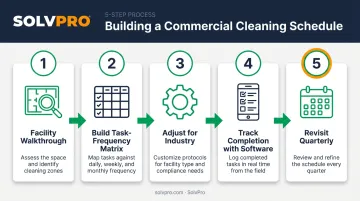
1. Start with a facility walkthrough. Assess square footage, foot traffic patterns, hours of operation, and any industry compliance requirements before assigning a single frequency. A 24-hour call center has different needs than a 9-to-5 professional office.
2. Build a task-frequency matrix. Every task needs three things: an owner, a frequency, and a specific area. "Clean the office" isn't a task. "Disinfect reception desk and door handles, daily, opening shift" is.
3. Adjust for industry. Medical facilities, restaurants, and industrial sites layer stricter requirements on top of the baseline schedule, whether that's more frequent disinfection or code-driven exhaust cleaning.
4. Solve the real failure point: tracking. Follow-through, not the checklist itself, is usually where schedules break down. Paper logs and spreadsheets let missed tasks slip through until a client complains. Platforms like SolvPro close that gap, giving office teams:
- Recurring job scheduling that automatically builds daily, weekly, and monthly cycles across multiple client locations
- Time entries and photo uploads recorded against the job, so crew check-ins and proof of service are tied to a specific time and place
- Real-time completion tracking, flagging jobs as active, delayed, or complete without waiting for an end-of-shift report
- Digital work orders with site-specific instructions, so every crew member knows exactly what's expected at each location
That visibility replaces guesswork with proof: a specific job, address, and time stamp for every task completed.
5. Revisit the schedule quarterly. Client feedback, seasonal needs, and inspection results should all feed back into adjustments. A schedule that worked in January might need tweaking by summer.
Conclusion
A written, frequency-based schedule turns cleaning from guesswork into a repeatable operation your clients can trust. The best schedules balance thoroughness with efficiency, covering daily essentials without wasting hours over-cleaning low-priority areas.
Pairing that schedule with real tracking tools matters just as much as the plan itself. Platforms like SolvPro give office teams visibility into which crews completed which tasks and locations, backed by documented records instead of an unchecked paper trail.
This pairing of schedule and accountability keeps crews on track and clients satisfied well beyond the first job.
You shouldn't have to wait until the job is over to find out whether you made money.
Keeping the estimate, work order, time entries and invoice on one record reduces how much the office has to reconstruct before it can bill. That is the difference between finding out now and finding out at closeout. When you want to see it on your kind of work, Book a Demo.
Run the Job. Protect the Profit.
Frequently Asked Questions
What Is a Good Weekly Cleaning Schedule?
A good weekly schedule builds on daily basics by adding detail work: floor edges, interior glass, appliance interiors, and restroom grout. Schedule these during slower business hours to minimize disruption.
What Are the 7 Stages of Cleaning?
There's no universal "7 stages" standard in commercial cleaning. Food-service and clinical settings follow sector-specific steps, such as pre-clean, wash, rinse, disinfect, dry, inspect, and restock, but general janitorial work doesn't follow one fixed sequence.
How Often Should Commercial Carpets and Floors Be Deep Cleaned?
High-traffic carpet typically needs extraction every one to three months, while lower-traffic areas can often go quarterly or annually. Hard floors generally benefit from monthly machine scrubbing, adjusted for actual foot traffic.
What's the Difference Between Janitorial Cleaning and Commercial Deep Cleaning?
Janitorial cleaning covers daily upkeep of high-touch and visible areas, like trash removal and restroom sanitation. Deep cleaning is a more intensive, periodic service, such as carpet extraction or floor stripping, scheduled weekly or monthly.
Do Small Businesses Need a Formal Cleaning Schedule?
Yes. Even a small office benefits from a written schedule, since it prevents skipped tasks and gives you a clear standard to hold any cleaning vendor or in-house staff accountable to.
How Can Software Help Manage a Commercial Cleaning Schedule?
Scheduling software like SolvPro assigns tasks to specific crew members, confirms completion in real time, and flags missed or delayed cleanings. That beats paper logs, which only reveal gaps after a client complains.