A general contractor's estimate is judged before a single hammer swings. Clients line up three or four bids side by side, and the numbers do the talking before your reputation ever gets a chance to.
Here's the pain point: unlike a single-trade sub pricing one scope, a GC has to price every trade, every phase, and every dollar of a project at once.
Miss a few line items, an unpriced permit fee, an unaccounted-for demo day, and you've either lost the bid or lost the profit.
This guide fixes that gap. It covers the four estimate types you'll actually use, what GCs really charge according to current industry benchmarks, a step-by-step build process, the profit-killing mistakes to avoid, and whether spreadsheets still cut it in 2026.
KEY TAKEAWAYS
- Four estimate types cover the project lifecycle: preliminary, detailed, quantity, and bid
- Recent benchmarking data puts gross margins at 20-26%, not the 40%+ often quoted online
- A repeatable, phase-by-phase process closes the scope gaps that eat profit silently
- Purpose-built estimating tools remove version-control errors and connect estimates straight to job costing
- Estimates that carry into job costing let actual spend be checked while the job is still open
What Is a General Contractor Estimate? (and the 4 Types You'll Use)
A construction estimate forecasts the total cost of a project (materials, labor, equipment, subcontractor pricing, overhead, and profit) built from a material takeoff and, ideally, real sub quotes rather than guesses.
Accuracy cuts both ways. Clients use your number to secure financing and set expectations with their own stakeholders. You use it to win work without accidentally subsidizing the job out of your own pocket. A number that's too high loses the bid; one that's too low turns a "won" project into a loss once it's underway.
The 4 Main Types of Construction Estimates
Each type matches a different stage of the project:
- Preliminary estimate: A rough order-of-magnitude figure used early, before designs are finalized. Think budget conversations, not contracts.
- Detailed estimate: A comprehensive, line-by-line breakdown built from complete drawings and specs. This is what you submit for formal bidding.
- Quantity (unit cost) estimate: Takeoff-driven pricing that focuses on quantities and per-unit costs rather than one lump total. Useful for comparing material or labor pricing across scenarios.
- Bid estimate: The final, client-ready number. It combines direct costs with your markup for overhead, profit, and contingency into a single submitted figure.
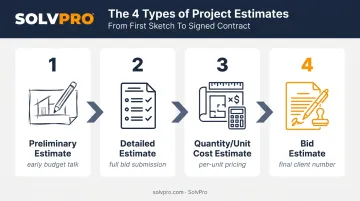
Most GCs move through all four at different points on the same project: starting rough, getting detailed as drawings firm up, and landing on a bid number once scope is locked.
What Do Most General Contractors Charge? (Markup & Profit Margin Explained)
Markup and margin get confused constantly, and mixing them up is an easy way to underprice a job.
Markup is what you add on top of your direct cost. Margin is what percentage of the final price that markup actually represents. They're not the same number.
Here's the math: if your direct cost is $100 and you apply a 50% markup, your price is $150. Profit is $50 on a $150 price, which is a 33% margin, not 50%. A lot of contractors think they're running healthy margins when they're actually running a much thinner one.
What the Current Data Actually Shows
Industry benchmarking has moved away from the old "35-50% gross margin" rule of thumb you'll still see quoted around the web. Recent data tells a more grounded story:
- Single-family home builders reported an average 20.7% gross margin and 8.7% net margin in NAHB's 2023 financial performance results
- NAHB's 2024 home-cost survey put overhead and general expenses at 5.7% of sales price, with pre-tax builder profit at 11.0%
- CFMA's 2024 Construction Financial Benchmarker found gross margin averaging around 26% across 1,290 companies, with net income before tax at just 6.3%
- The top-quartile "Best in Class" contractors in that same CFMA study hit 21.8% gross profit and 11.9% pre-tax net margin, proof that the gap between average and excellent is real money
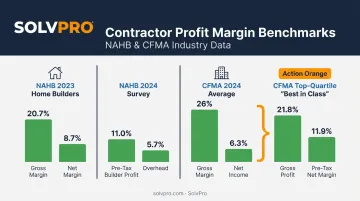
What this means for your bid: aim for gross margin in the low-to-mid 20s if you're a typical GC, and treat anything approaching the high 20s as top-quartile performance, not the baseline.
A few practical notes on applying these numbers:
- Subs are commonly marked up 10-15% to cover coordination time, liability exposure, and payment processing. This is standard practice, not padding
- Remodels with hidden conditions (old wiring, unknown framing, water damage behind walls) often justify markups higher than a predictable new build, because your risk exposure is higher
- Margins below roughly 20% are a warning sign. Factor in warranty callbacks and unbilled project management hours, and that "profitable" job may just be breaking even
How to Build an Accurate General Contractor Estimate (Step-by-Step)
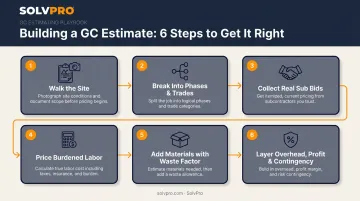
A repeatable process is what separates a bid that protects your margin from one built on hope. Here's the sequence that works:
- Walk the site first. Document existing conditions with photos, measurements, and notes on hidden risks — old wiring, water stains, outdated plumbing. This visit is where you catch the surprises before they catch you.
- Break the project into phases and trades. Pre-con and permits, demo, structural, MEP, finishes, fixtures. Organizing this way is the single biggest defense against missed line items.
- Collect real sub bids, not allowances. A single trade's bid spread can shift your total by thousands. Guessing on plumbing or electrical because you're in a hurry is how estimates go sideways.
- Price self-performed labor with a burdened rate. Your wage plus workers' comp, taxes, insurance, and benefits, not just the hourly rate you pay. Per USACE guidance, insurance and taxes alone can run 20% or higher depending on your location and trade.
- Add materials with a waste factor sized to the specific material, not a blanket guess. A job costing tool that tracks labor, materials, and overhead in real time, like SolvPro, keeps these numbers accurate as the job progresses.
- Layer in overhead, profit, and contingency. A 5-10% contingency is standard for remodels where hidden conditions are common; public-sector benchmarks from the GSA use 7% for new construction and 10% for repairs and alterations as a reference point.
What Every Estimate Needs Beyond the Numbers
A price alone isn't a complete estimate. Every one you send should include:
- Scope-of-work language spelling out exactly what's included and excluded, such as furniture, landscaping, appliances, and anything else a client might assume is covered
- A milestone-based timeline and payment schedule tied to project phases (foundation complete, rough-in done, final walkthrough) rather than arbitrary calendar dates
- A defined change order process and clear workmanship warranty terms, so nobody's guessing what happens when scope shifts mid-project
- License, insurance, and bonding information, since commercial clients and increasingly savvy homeowners will ask for this upfront
Common GC Estimating Mistakes That Quietly Eat Your Profit
Even experienced contractors leak margin through the same handful of gaps, over and over.
Skipping general conditions on commercial work. Supervision, temporary power, dumpsters, and safety equipment are project-level costs that add up fast. RSMeans data places general conditions at 5-15% of total project cost including overhead and profit, with 10% as a typical allowance. Leave this line off a commercial bid and you're absorbing it yourself.
Other quiet profit leaks show up just as often:
- Using allowances instead of confirmed bids. A guessed sub price rarely matches the number that shows up on the actual invoice.
- Assuming flat permit fees. Permit and inspection costs are driven by project valuation and jurisdiction, so pull your local fee schedule instead of estimating from memory.
- Skipping your own project management time. PM hours rarely get their own line item, even though they're real labor cost.
- Leaving out contingency. Without a cushion, there's no room for the unexpected change order that always seems to land mid-job.
Each of these looks harmless on paper, until the budget breaks around week three.
Estimating Software vs. Spreadsheets: What Actually Protects Your Margins
Spreadsheets work fine until the business grows past one estimator and one job at a time. Then the cracks show:
- Version-control confusion — which tab is the current bid, and which one did you already send the client?
- Formula errors that silently understate a total because one cell got overwritten
- No live connection to actual job costs, meaning your "estimate" and your "actuals" live in two different worlds until someone manually reconciles them
Purpose-built estimating tools close those gaps, often in the same order they appear above:
| Spreadsheet Problem | What Software Fixes |
|---|---|
| Version-control confusion over which tab is current | One accurate bid, always up to date |
| Formula errors that silently understate totals | Automated calculations, no manual overwrites |
| No live connection to actual job costs | Real-time job cost tracking tied to the estimate |
This is where a platform like SolvPro fits into the picture. Its online estimates and digital proposals let you build multi-stage line items, send a customer-facing PDF with e-signature built in, and track approval status without chasing a callback. Once a client signs, the estimate converts straight into a job, and there's no re-keying numbers into a separate invoicing system.
From there, knowing what each job made pulls labor hours, material costs, and change orders into one view in real time. You're not waiting until the job closes to find out if you actually made money. Add QuickBooks Online sync, and the whole path from estimate to invoice to payment collection runs through one connected system.
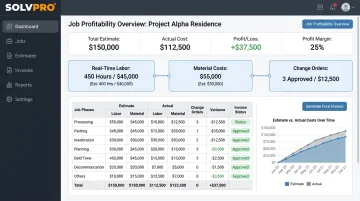
For a GC bringing on their first estimating software, same-day guided onboarding means you're not stuck reading a manual. A live person walks you through setup so your next bid goes out the same way, just faster and cleaner.
Conclusion
Run a profitable shop, not just a busy one.
Seeing what a job is costing while it is still open gives you a chance to act on it. SolvPro connects scheduling, work orders, time, job costing and invoicing so that information is in one place. When you want to see it on your kind of work, Book a Demo.
Run the Job. Protect the Profit.
Frequently Asked Questions
What Do Most General Contractors Charge?
Recent industry benchmarking shows gross margins averaging 20-26%, with top-quartile "Best in Class" contractors closer to 21.8% gross profit. The old 35-50% figure doesn't hold up against current NAHB and CFMA data.
What Are the 4 Types of Estimate?
Preliminary, detailed, quantity (unit cost), and bid. Each one corresponds to a different stage of the project, from early budget talk to the final client-ready number.
What's the Difference Between an Estimate, a Quote, and a Bid?
An estimate is a ballpark based on known information and can shift as details firm up. A quote is a fixed price for a clearly defined scope. A bid is your formal, final submission in a competitive process.
How Long Should It Take to Put Together a GC Estimate?
It depends heavily on project complexity, so there's no universal standard. A straightforward remodel might take a half-day, while new builds or complex commercial TI projects can stretch across several days with multiple estimators.
Should I Mark up Subcontractor Costs on My Estimate?
Yes. A 10-15% markup on sub costs is standard practice, since you're managing scheduling, quality control, and liability for work you didn't perform yourself.
What Is a General Conditions Line Item on a GC Estimate?
General conditions cover project-level costs like supervision, temporary power, and dumpsters. RSMeans data pegs this at 5-15% of total project cost, with 10% typical on commercial jobs, and it's one of the most commonly missed line items on a bid.