This guide is written for general contractors, electrical, plumbing, landscaping, excavation, and other multi-crew field service teams. With margins as thin as they are in construction, a few percentage points of untracked cost can turn a "profitable" job into a loss.
Here's what you'll get: a clear definition of job costing, the seven-step process behind it, the cost categories that drive it, and the mistakes that quietly erode profit on otherwise well-run jobs.
KEY TAKEAWAYS
- Job costing tracks labor, materials, equipment, and subcontractor costs against budget to reveal profitability
- Construction net income before taxes averages just 6.3% of revenue, per CFMA's 2024 Benchmarker, leaving little margin for error
- The process follows a repeatable loop: estimate, capture, allocate, compare, and refine
- Logging field data in real time yields more accurate cost reports and sharper bids
- Costs captured while the job is still open can change the outcome, whereas costs reconciled after closeout only inform the next bid
What Is Construction Job Costing?
Job costing ties every direct and indirect cost to a specific project so contractors can compare actual spend against the original estimate. The goal is simple: know whether a job made or lost money, and understand exactly why.
This isn't the same as general ledger accounting. Your general ledger shows business-wide financial health, including revenue, expenses, and cash position, across every job combined. Job costing zooms into one project at a time, isolating its costs and profitability from everything else happening in the business.
Process costing, which manufacturers use for standardized, repeatable production runs, works differently too. Construction doesn't work that way. Every project has a different site, crew mix, and scope, so contractors rely on job-order costing to trace costs to unique, non-repeatable work.
The Three Cost Classifications
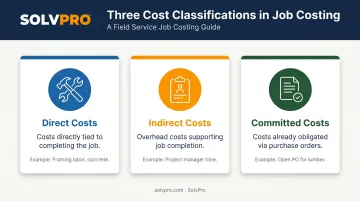
Job costing sorts every dollar into one of three buckets:
- Direct costs — expenses tied directly to the job, such as framing labor or concrete for a specific pour
- Indirect costs — costs that support the job but aren't tied to one task, like a project manager's time split across three jobs
- Committed costs — money you're obligated to spend but haven't been invoiced for yet, such as an open purchase order for lumber
The Job Costing Formula
The math behind job costing is straightforward:
Total Job Cost = Direct Labor + Materials + Equipment + Subcontractors + Indirect Costs + Overhead Allocation
Subtract that total from the contract price, and you get your actual profit margin: the number the job actually earned, calculated after the work is done rather than projected at bid time.
Why Job Costing Matters for Contractors
Contractors adopt job costing for three reasons: protecting margin, bidding more accurately, and catching budget problems while there's still time to fix them.
The stakes are real. CFMA's 2024 Benchmarker found average net income before taxes ranging from 4.1% for industrial and nonresidential contractors up to 6.9% for specialty trade firms, based on CFMA's fiscal 2023 data from 1,290 companies.
At those margins, a single underbid job can wipe out the profit from two others.
Without job costing, problems hide in plain sight. Common blind spots include:
- Underbidding because labor burden (payroll taxes, insurance, benefits) got left out of the estimate
- Equipment sitting idle on-site while still costing money in depreciation or rental fees
- Jobs that look profitable on the surface but lose money once overhead gets factored in
Job costing requirements also shift by contract type. Cost-plus and time-and-materials contracts typically require audit-ready documentation, since AIA's cost-plus contract language requires detailed Cost of the Work records that owners and auditors can access on request.
Fixed-price contracts work differently: since you bear the risk of overruns, you need early variance tracking to catch cost creep before it eats your fee.
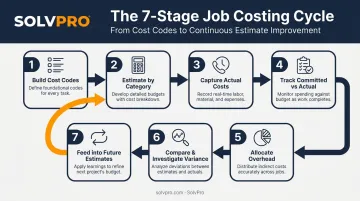
The 7-Step Job Costing Process
Job costing flows from the original estimate through to the final wrap-up report, and ideally, back into your next bid. The inputs are estimated costs, cost codes, and budgets. The outputs are variance reports and real profitability data you can actually use.
Step 1: Build Your Cost Code Structure
Before tracking a single dollar, break the project into cost codes or phases, such as foundation, rough-in, and trim-out. Most specialty contractors find 8 to 15 codes per project workable without becoming overwhelming to manage.
Step 2: Estimate Costs by Category
Your estimator assigns projected labor hours, material quantities, equipment needs, and subcontractor bids to each cost code. This becomes your budget baseline, the number every future comparison gets measured against.
Step 3: Capture Actual Costs at the Source
Labor hours, material purchases, and equipment usage need to be logged as close to real time as possible. Reconstructing costs days later from memory or scattered notes is the single most common source of bad job cost data.
Mobile crew tracking helps here. SolvPro's time tracking, for example, lets crews log hours through manual entries or live timers directly from a phone, job-linked by job and crew member. That data flows straight into job costing without someone re-typing a paper timesheet back at the office.
Step 4: Track Committed vs. Actual Costs
Committed costs include open purchase orders and signed subcontractor agreements you haven't been invoiced for yet. Actual costs are what's already hit your books. Tracking both matters because relying on invoices alone means you find out about overspending only after it's too late to course-correct.
Step 5: Allocate Indirect Costs and Overhead
Project management time, safety compliance, shop overhead, office rent, insurance—none of this disappears just because it's harder to trace to a single job. Allocate it consistently across every project, or your profitability numbers will be fiction.
Step 6: Compare Actual to Budget and Investigate Variance
Run variance reports on a regular cadence; weekly is a solid benchmark. If any category runs meaningfully over budget, dig into the cause immediately rather than waiting for the post-mortem.
Step 7: Feed Results Back into Future Estimates
Every finished job adds real cost history to your estimating database. Over time, this turns your bids from educated guesses into numbers grounded in what jobs actually cost you.
Key Cost Categories That Drive Job Costing
Four categories make up nearly every construction budget, and each one has its own tracking headaches.
| Cost Category | Main Tracking Challenge | Why It Matters |
|---|---|---|
| Labor | Hours and cost codes captured inconsistently in the field | Often the most variable cost; drives productivity swings |
| Materials | Price shifts between estimate and purchase, plus waste | Requires logging both PO creation and delivery receipt |
| Equipment | Owned vs. rented, utilization vs. idle time | Prevents paying for machinery that sits unused on-site |
| Subcontractors | Original bid vs. change orders vs. actual invoice | Blending these hides where the variance actually came from |
Labor tends to carry the most risk. According to Construction Executive's analysis of labor productivity losses, the U.S. construction industry logs $270 billion in annual labor costs, with roughly $40 billion tied to inefficiencies alone. That scale makes labor the category that rewards accurate, real-time tracking more than any other.
These categories don't operate in isolation. A labor overrun on a job usually drags equipment and material costs along with it. Extra days on-site mean extra rental fees and often extra material waste from rushed work.
Overhead allocation ties it all together. Common methods include direct labor hours, direct labor cost, and revenue-based allocation. The method you choose changes how profitable a job appears on paper. Pick one that reflects how your overhead is actually driven, then apply it consistently across every job.
Common Job Costing Mistakes & Best Practices
Even contractors who understand job costing in theory often get tripped up by the same handful of mistakes in practice.
Mistake 1: Delayed field data entry. When hours and receipts get logged days after the work happens, your job cost report is stale before anyone even opens it.
Mistake 2: Mixing change orders into the original budget. If a client-requested change gets blended into the base budget, you can't tell whether a variance is the client's responsibility or a productivity problem on your end.
Mistake 3: Leaving out indirect costs and overhead. Skip these, and jobs look more profitable than they really are, right up until you wonder why the bank account doesn't match the reports.
The fix for most of this isn't more spreadsheets. It's capturing data where the work actually happens:
- Use mobile time tracking so labor hours post the moment they're worked, not at week's end
- Keep change orders as separate line items, never folded into the original scope
- Build overhead allocation into every estimate template so it's never an afterthought
Platforms like SolvPro combine crew scheduling, mobile time tracking, and digital estimates so cost data moves from the field to the office without manual re-entry.
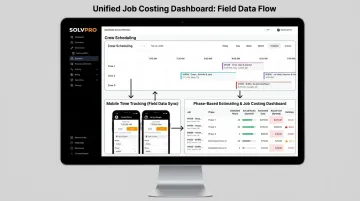
Add in QuickBooks Online sync and built-in credit-card and ACH payments, and contractors get a clearer read on job profitability while getting invoices out the door and paid faster.
Conclusion
Your crews are busy. So why isn't there more money in the bank?
When the office can see labor, materials and documented changes against the job while the work is still open, the numbers at the end stop being a surprise. SolvPro keeps scheduling, work orders, time, job costing and invoicing on one record. When you want to see it on your kind of work, Book a Demo.
Run the Job. Protect the Profit.
Frequently Asked Questions
What Is Job Costing for Contractors?
Job costing tracks actual costs, labor, materials, equipment, and subcontractors, against the estimated budget for a specific project. It tells you whether that individual job was profitable, not just how the business performed overall.
What Are the 7 Steps of Job Costing?
Build cost codes, estimate by category, capture actual costs at the source, track committed vs. actual costs, allocate indirect and overhead costs, compare actual to budget, and feed results into future estimates.
What Is the Formula for Job Costing?
Total Job Cost = Direct Labor + Materials + Equipment + Subcontractors + Indirect Costs + Overhead. Subtract this total from your contract price to find actual profit.
How Is Job Costing Different from General Accounting?
General accounting shows your business's overall financial health across every job combined. Job costing isolates costs and profitability at the level of one specific project.
How Often Should Job Costing Be Updated During a Project?
Ideally, daily or weekly. Frequent updates let managers catch overruns while there's still time to adjust, rather than discovering the damage after the project wraps.
What Software Helps with Construction Job Costing?
Dedicated field service software that integrates time tracking, scheduling, and cost data reduces the manual errors common with spreadsheets or paper timesheets. Platforms like SolvPro give contractors real-time job-level cost reporting instead of a rearview mirror.