Many cleaning business owners still run on spreadsheets, disconnected apps, and endless text messages. The result? Missed shifts, billing disputes, and clients who question whether the work actually got done. The industry is shifting toward centralized, mobile-first platforms that fix exactly these problems.
This article breaks down where the market stands today, the five biggest trends reshaping vendor offerings, what's fueling the shift, and what janitorial business owners should watch for next.
KEY TAKEAWAYS
- The global janitorial software market is valued at $2.43–$3.73 billion in 2024, with steady growth expected through 2032
- AI-driven scheduling, GPS verification, and all-in-one platform consolidation are reshaping vendor offerings
- Cloud-based, subscription software is outpacing on-premise systems due to lower upfront cost and easier scaling
- Regulatory pressure around hygiene and compliance is driving adoption in healthcare, education, and hospitality
- Buyers now prioritize workforce accountability and multilingual support as crews grow more distributed
Key Trends Shaping the Janitorial Software Market
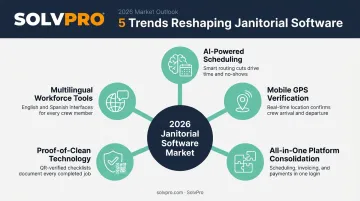
Five converging trends define where this market is headed in 2026 and beyond. Each one addresses a specific pain point that's been dragging down cleaning businesses for years.
AI-powered Scheduling and Predictive Workforce Management
Basic drag-and-drop scheduling is old news. Today's platforms use AI to predict no-shows, auto-fill open shifts, and forecast staffing needs for recurring contracts before a problem hits.
Here's why it matters: cleaning work runs on thin margins, and every missed shift creates a scramble. A crew member who doesn't show up to a nightly office cleaning contract can mean an angry client call the next morning.
Why this trend is accelerating:
- Labor shortages make every open shift harder to fill, and thin margins turn each missed shift into a real financial hit, not just an inconvenience
- The industry sees roughly 2,447,700 janitorial and building cleaner jobs with an estimated 351,300 openings per year through 2034, according to BLS occupational data
Predictive attendance tools flag risk patterns (like a crew member who's been late three shifts running) before they turn into a no-show. That's a meaningful shift from reactive scrambling to proactive coverage.
Mobile-First, GPS-verified Field Operations
Manual check-ins are disappearing. Geolocation and geofencing now confirm crews are on-site, at the right time, without a phone call to the office.
This matters because billing disputes are common in janitorial contracts. A client questions an invoice, and without proof, it's the cleaning company's word against theirs. GPS-verified time stamps end that argument before it starts.
This is where tools like SolvPro's job and crew time tracking fit in. Time entries, photo uploads, and job status updates get job-linked the moment they happen, creating a location-verified audit trail. Growing cleaning companies get proof-of-service without needing enterprise-level complexity or a dedicated IT team to manage it.
What gets documented:
- Time entries tied to the job, showing when and where work happened
- Photos captured directly from the job site
- Job status updates marked in real time as work starts and finishes
- Customer sign-off captured on-site
Vendor-reported data shows the scale of this shift: Janitorial Manager logged more than 2.2 million QR code scans through its Scan4Clean tool between October 2024 and March 2026, according to ISSA's industry news coverage. That's a lot of clients checking, in real time, whether a space actually got cleaned.
Consolidation into All-In-One Platforms
Fragmented tools are on their way out. Cleaning businesses used to run separate apps for bidding, inspections, time tracking, and payroll. Now they want one login that holds everything.
This isn't just a cleaning-industry phenomenon. Broader field service software consolidation backs it up. Simpro Group acquired BigChange in October 2024 to expand its field service offering. PTC followed with a $1.46 billion acquisition of ServiceMax in early 2023, folding service management into a larger product platform.
Why owners want fewer logins:
- Manual re-keying of the same job data wastes hours every week
- Disconnected tools create disconnected data across separate systems
- Fragmented data turns routine reporting into a headache for already-stretched owners
- One platform means one place to train new office staff
The direction is clear even without a cleaning-specific mega-deal: vendors are racing to add features rather than staying narrow point solutions.
Quality Control and Proof-Of-Clean Technology
Clients no longer accept "trust us, it's done." They want proof. QR-code check-ins, photo-based inspections, and IoT sensors now score and document service quality as it happens, not after a complaint.
ISSA case studies back up the operational upside of this shift. One school district reported 20% shorter cleaning times and 15% higher cleaning efficiency after adopting data-driven cleaning practices. A university saw 30% lower water use and 20% lower chemical consumption with the same approach, per ISSA's data-driven cleaning report.
Common proof-of-clean tools in use today:
- QR/NFC tags that open location-specific checklists and log task completion
- Mobile inspection apps tied to corrective-action tickets when something's missed
- IoT entrance sensors that trigger restroom attention based on actual foot traffic, not just a fixed schedule
Inspection apps that automatically generate corrective-action tickets close the loop fast. A missed task gets flagged, assigned, and fixed the same shift, instead of surfacing three weeks later in a client complaint.
Multilingual and Inclusive Workforce Tools
Bilingual support has moved from optional to essential. Cleaning crews skew heavily Hispanic or Latino, with 35.6% of employed U.S. janitors and building cleaners identifying as Hispanic or Latino in 2025, per BLS employment data.
Language barriers cause real damage on the job. A missed safety instruction or a miscommunicated task drives turnover in an industry that already runs hot.
Where bilingual support shows up in practice:
- Office dashboards available in Spanish, not just field-facing tools
- Mobile apps where crews can log time, view job instructions, and submit photos in their preferred language
- Customer communications that work in either language
SolvPro builds this in as a fully bilingual English/Spanish interface across both the office dashboard and the mobile field app, covering scheduling, invoicing, time tracking, and customer communications rather than a handful of translated buttons. It's included at no extra cost on the core plan.
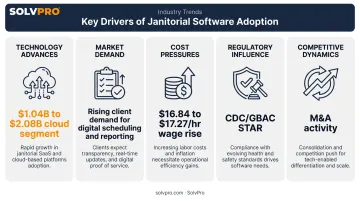
What's Driving These Janitorial Software Trends
A mix of technology, economics, and regulation is accelerating adoption across the board.
- Technology advances: Affordable cloud and IoT tools now bring up-to-date job information to small operators, not just enterprise accounts. Market Research Future values the cloud-based segment at $1.042 billion in 2023, growing to $2.08 billion by 2032.
- Market demand: Clients increasingly expect documented proof of service before renewing a contract, not just a completed checklist.
- Cost pressures: U.S. janitor wages rose from $16.84/hour in May 2023 to $17.27/hour in May 2024, a 2.6% increase. Automating payroll and scheduling protects thinning margins.
- Regulatory influence: CDC guidance pushes healthcare facilities toward software that can document direct observation, checklists, and ATP testing. Accreditations like GBAC STAR add further pressure to prove infection-prevention protocols.
- Competitive dynamics: Ongoing M&A in adjacent field service software widens the gap between basic tools and full-suite platforms, pressuring vendors to innovate faster.
How These Trends Are Impacting the Janitorial Industry
These shifts aren't theoretical. They're changing daily operations, business strategy, and even hiring criteria for cleaning companies right now.
Operational Impact
Centralizing scheduling, time tracking, and communication into one system cuts admin time and reduces missed or delayed jobs. When a crew lead can see the schedule, log time, and flag a problem from one app, there's no gap for a job to fall through. A two-person crew running five stops a day, for instance, can log arrivals and flag supply shortages without a single call to the office.
Business Impact
Job-level profitability reporting is replacing guesswork. Instead of estimating costs after a job wraps, owners can see labor, materials, and margin per job as it happens. Platforms like SolvPro surface real-time profit insights, tracking labor and material costs against job revenue so pricing decisions are based on actual data, not a hunch.
Workforce Impact
Digital literacy and comfort with mobile apps are now hiring considerations for field crews, right alongside reliability and attention to detail. Multilingual onboarding has moved from a nice-to-have to a practical necessity, given how many crews communicate primarily in Spanish.
Future Signals to Watch in Janitorial Software
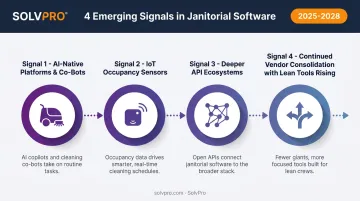
The next one to three years will bring a few clear shifts worth tracking:
- AI-native platforms and co-bots will move further into high-volume facilities, with autonomous cleaning equipment supplementing (not replacing) human crews on repetitive tasks.
- IoT occupancy sensors and predictive maintenance will get more common, letting software adjust cleaning frequency based on actual foot traffic rather than a fixed calendar.
- Deeper API ecosystems will connect janitorial platforms to client-side facility systems, so proof-of-service data flows directly into a building manager's own dashboard.
- Vendor consolidation will continue, but expect a parallel rise in lean, mobile-first tools built specifically for small and mid-size crews who don't need (or want) enterprise complexity.
That last point matters most for smaller cleaning operations. Platforms like SolvPro reflect this shift, giving crews scheduling, job costing, and invoicing without the setup time or price tag of enterprise systems.
Conclusion
AI-driven scheduling, mobile GPS verification, platform consolidation, proof-of-clean technology, and multilingual support are reshaping how janitorial businesses operate and compete. None of these trends are optional add-ons anymore. They're becoming baseline expectations from clients who want documented, accountable service.
Businesses that adopt the right tools early gain a real edge in client retention and margin protection, while those still running on spreadsheets and group texts fall further behind.
SolvPro was built for exactly this shift. It gives growing janitorial and commercial cleaning crews mobile GPS tracking, a fully bilingual English/Spanish interface, and centralized job and payment data, all without enterprise-level complexity or long-term contracts. Setup takes under 10 minutes, and you can start a free trial without a credit card.
Field service software helps you manage the work. SolvPro helps you make sure the work makes money.
The right tool depends on your trade, crew size, job mix and the systems you already run. Test it on real jobs before you commit, and check that crews will actually enter what the office needs. When you want to see it on your kind of work, Book a Demo.
Run the Job. Protect the Profit.
Frequently Asked Questions
What Janitorial Software Do Cleaning Companies Use?
Cleaning companies may use janitorial-specific platforms for scheduling, inspections and site verification alongside broader field service tools such as SolvPro. The right fit depends on business size and how much commercial-cleaning-specific functionality is needed.
What Is Driving Growth in the Janitorial Software Market?
AI automation, rising labor costs, client demand for documented proof-of-service, and regulatory compliance needs are the primary growth drivers. Together, they're pushing even small cleaning operators toward digital tools.
How Much Does Janitorial Software Typically Cost?
Pricing ranges from around $20-30/month for basic small-crew tools to several hundred dollars monthly for full-suite platforms. SolvPro does not publish pricing, with enterprise ERP systems requiring custom quotes.
Is Janitorial Software Different from General Field Service Management Software?
Janitorial-specific tools tend to emphasize inspections, supply tracking, and multi-site verification. General field service platforms like SolvPro offer broader scheduling, invoicing, and crew management flexible enough to handle cleaning operations too.
What Features Should I Look for in Janitorial Software for a Growing Cleaning Business?
Prioritize mobile time tracking, GPS/geofencing, multilingual support, and QuickBooks or payment integrations. These four features cut the most admin time and get invoices paid the fastest, based on common cleaning-business workflows.
Will AI and Robotics Replace Human Cleaning Crews?
No. AI and robotics are augmenting scheduling, quality checks, and repetitive tasks, not replacing crews. Human oversight remains central to service quality, especially for detail work and client-facing accountability.