Here's the catch: there's no single "commercial cleaning rate." Costs swing based on facility type, square footage, cleaning frequency, your local labor market, and how much specialty work is bundled into the job.
This guide breaks down 2026 pricing by service type and pricing model, the variables that push rates up or down, and a practical process for pricing jobs so you actually keep the profit you're supposed to.
Key Takeaways
- Typical 2026 rates: $0.07-$0.30/sq. ft. or $30-$75+/hour, depending on facility type
- Labor eats up 50-70% of total job cost — price it accordingly
- Medical, industrial, and post-construction jobs price higher due to compliance and specialized labor
- One-time and deep cleans should always cost more per visit than recurring contracts
- Businesses that track job costing regularly protect margins better than those quoting from memory
How Much Does Commercial Cleaning Cost in 2026? (Pricing Overview)
There's no fixed sticker price for commercial cleaning. Costs depend on facility type, frequency, scope of work, and what your local labor market demands. A 3,000 sq. ft. dental office and a 3,000 sq. ft. warehouse office will not cost the same to clean, even though the square footage matches.
Three things consistently sink pricing:
- Underbidding with outdated national averages instead of local labor and overhead numbers
- Ignoring payroll burden: taxes, insurance, and benefits stacked on top of base wages
- Folding specialty add-ons into a flat rate instead of pricing them as separate line items
Commercial Cleaning Rates by Pricing Model
Most cleaning businesses quote using one of three models, and each fits a different type of job.
Per-square-foot pricing runs roughly $0.05-$0.25 per sq. ft., based on ISSA's 2025 commercial cleaning rate guide. This model works best for recurring jobs where the scope is stable, since you already know the layout, frequency, and what's included, making per-square-foot pricing predictable for both you and the client.
Hourly pricing typically falls between $25-$60 per hour nationally, higher in major metros. This model fits one-time jobs, first-time cleans, or situations where scope is unclear until you're on-site. If you don't know how long a job will take, don't lock into a flat rate. Bill hourly until you have real data.
Flat-rate contracts are a calculated output, not a separate market price. Once you know labor hours, supply costs, and overhead for a specific account, you convert that into a flat monthly or per-visit number. This model only works once the scope is genuinely well understood; guessing at flat rates is how margins disappear.
Commercial Cleaning Rates by Facility and Service Type
Facility type changes pricing more than almost any other variable. Compliance requirements, PPE, and specialized equipment all add cost.
| Facility Type | Per Sq. Ft. | Hourly Rate |
|---|---|---|
| Office | $0.09-$0.18 | $35-$50 |
| Retail | $0.07-$0.22 | $40-$55 |
| Medical/Healthcare | $0.14-$0.35 | $55-$70 |
| Industrial/Manufacturing | $0.08-$0.28 | $50-$65 |
| Post-construction | Quoted by scope | $45-$75 |
Medical and industrial facilities generally price higher than office or retail work because of hygiene standards, exposure-control procedures, and required documentation. Post-construction cleaning is usually quoted job-by-job rather than by a fixed per-square-foot rate, since debris volume and site condition vary too much for a standard formula.
Add-on services should always be priced separately, not buried in a flat rate:
- Carpet cleaning: $0.08-$0.25 per sq. ft.
- Floor stripping and refinishing: $0.30-$0.60 per sq. ft.
- Floor scrubbing and recoating: $0.20-$0.40 per sq. ft.
- Electrostatic disinfection: $0.10-$0.30 per sq. ft.
- Window washing: typically quoted per job based on access and height
Price Ranges by Business/Facility Size
Facility size affects your per-square-foot rate because setup time, travel, and supervision costs don't scale evenly.
- Small spaces (under 5,000 sq. ft.): $0.15-$0.20 per sq. ft., best suited to a single cleaner in an entry-level pricing tier
- Mid-size facilities (5,000-20,000 sq. ft.): $0.10-$0.20 per sq. ft., the standard tier, often requiring a small crew
- Large facilities (20,000+ sq. ft.): $0.08-$0.16 per sq. ft., requiring multi-crew scheduling, with volume discounts becoming realistic
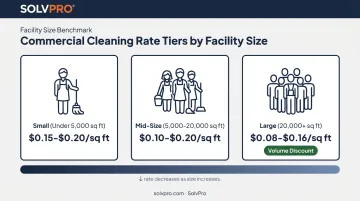
Smaller sites carry proportionally higher setup and overhead costs per square foot. Larger buildings spread those same fixed costs across more billable space, which is why unit pricing drops as size increases.
Key Factors That Affect Commercial Cleaning Rates
2026 pricing depends on more than square footage. Technical requirements, staffing logistics, and local market conditions all move the number.
Facility Type and Compliance Requirements
Offices and retail spaces are low-complexity environments: standard products, standard procedures. Medical facilities and food service operations are a different story entirely.
Facilities with occupational exposure to blood or other infectious materials fall under OSHA's bloodborne pathogens standard, which requires:
- A written exposure-control plan
- Paid initial and annual staff training
- Employer-provided PPE at no cost to employees
- Hepatitis B vaccination for covered staff
- Documented decontamination and regulated-waste handling
Food service cleaning carries its own rules, too. The FDA Food Code generally requires cleaning food-contact surfaces every 4 hours during use. None of this comes with a fixed price premium attached, but paid training time, PPE, and extra documentation all add real cost that needs to be priced in.
Size, Layout, and Cleaning Frequency
Beyond compliance costs, a facility's physical footprint shapes pricing just as directly. An open floor plan cleans faster than a maze of small offices and cubicles, even at identical square footage. Segmented layouts mean more doorways, more corners, and more time per square foot.
Frequency matters just as much:
- Nightly or weekly contracts earn volume-based pricing because labor time is predictable
- One-time visits cost more per square foot since there's no repeat efficiency to build on
- Higher-traffic spaces need more frequent service regardless of size
Scope of Work and Add-On Services
Bundling floor care, carpet cleaning, window washing, or disinfection into one flat rate feels simpler for the client. It's usually a mistake for you. When add-ons are itemized as separate line items, you protect your margin and give clients a clear reason to say yes to extra services rather than assuming everything's already covered.
Labor and Staffing Needs
Whatever scope you land on, one cost component dwarfs the rest. Labor is typically 50-70% of total job cost — the single biggest line item in any bid. But base wages are only part of the story.
According to BLS Employer Costs for Employee Compensation data, private-industry service occupations averaged $18.15 per hour in wages plus $5.48 in benefits as of early 2026. That's total benefits equal to roughly 30% of wages. Legally required benefits alone (Social Security, Medicare, unemployment insurance, workers' comp) add close to 11%.
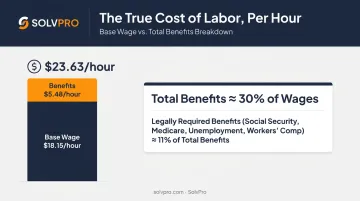
If you're only budgeting base wage into your labor cost, you're underpricing every job by nearly a third.
Location and Local Market Conditions
Where you operate compounds this labor math even further. Metro-area labor markets price differently than rural ones, driven by cost of living, wage competition, and local demand for cleaning staff.
There's no single verified national multiplier for "big city" pricing. The safest approach is pulling local BLS wage data for your specific metro and checking prevailing-wage requirements before you quote.
Equipment, Supplies, and Insurance Overhead
Labor and location set your biggest cost variables, but materials and overhead still move the final number. Green and eco-certified products can shift material costs in either direction: concentrated formulas and automated dilution systems sometimes lower consumption, but specialty equipment and certified supplies often cost more upfront.
Insurance and bonding overhead needs to be built into your rate, not absorbed as a cost of doing business. Many cleaning companies carry:
- General liability insurance
- Workers' compensation
- Commercial auto coverage
- Janitorial surety bonds
These premiums should be calculated as a per-hour or per-job cost and spread across your billable hours, not treated as a fixed monthly expense that quietly eats into every job's margin.
Cost Breakdown: What's Included in a Commercial Cleaning Quote
Total job cost is never just rate times square footage. A complete quote accounts for four components.
- Labor (recurring): The largest cost component. Wages plus payroll burden (taxes, insurance, benefits), not just the hourly rate you pay staff
- Supplies & equipment (recurring/periodic): Consumables, cleaning chemicals, and specialty tools needed for the specific scope
- Overhead & insurance (recurring): Admin costs, vehicle expenses, general liability, and janitorial bonding
- Profit margin (built into price): Added after break-even costs are calculated, not squeezed in as an afterthought
Industry estimates put cleaning business profit margins somewhere between 8% and 30%, with large competitive contracts often landing on the lower end and specialized or niche accounts commanding more.
Margin only holds if the first three cost categories are calculated accurately. Guess on labor or supplies, and that margin evaporates before the invoice goes out.
Job costing tools that track these costs in real time keep margin estimates honest instead of guesswork.
How to Price Commercial Cleaning Jobs Profitably in 2026
Profitable pricing starts with real cost data. Copying a competitor's rate card tells you nothing about your labor costs, your overhead, or your market.
- Calculate baseline costs. Add labor + payroll burden + supplies + overhead to find your break-even number for the job.
- Estimate cleaning time through a walkthrough. Account for restroom count, layout complexity, and building condition — don't guess from square footage alone.
- Match the job to the right pricing model. Per-sq-ft for recurring stable-scope work, hourly for one-time or unclear-scope jobs, flat-rate once the contract is well understood.
- Apply your target margin. Use break-even ÷ (1 − margin). Example: break-even costs of $500 with a 20% target margin gives you $500 ÷ 0.80 = $625.
- Track job costing and update pricing at least annually. Labor, supplies, and insurance costs don't stand still, and neither should your rate card.
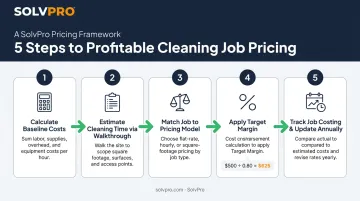
That last step is where most cleaning businesses fall short, simply because they lack real-time visibility into what a job actually costs versus what they quoted.
This is where a platform like SolvPro fits into the picture, giving crews real-time visibility into job costs instead of month-end surprises.
With SolvPro, growing cleaning crews can:
- Log time by job and crew member through mobile timers
- Track materials used on-site as they're consumed
- See labor and material costs roll into a real-time job profitability view
- Send invoices the moment a job is marked complete, shortening the gap between service delivery and payment
For a business running multiple recurring accounts, that combination of job costing and faster invoicing turns pricing decisions into a data exercise instead of a guessing game.
Common Pricing Mistakes to Avoid
Watch for these common pricing missteps:
- Relying on outdated national averages instead of pulling current local labor and overhead numbers
- Forgetting payroll burden when calculating hourly labor cost — that's roughly 30% you're leaving off the bottom line
- Bundling specialty add-ons into a flat rate instead of itemizing them, which invites scope creep and shrinks margins
- Skipping annual pricing reviews while wages, supplies, and insurance premiums keep climbing around you
Frequently Asked Questions
How do I calculate cleaning costs?
Add labor, overhead, and supply costs to find your break-even number, then divide by (1 − target margin). For example, $500 in costs with a 25% margin target: $500 ÷ 0.75 = $667.
Is 2 hours a week enough for a cleaner?
It depends on square footage and traffic. A small office under 1,000-2,000 sq. ft. with light daily use may only need 2 hours weekly, but larger or higher-traffic spaces need more frequent service.
How much should I charge per square foot for commercial cleaning?
2026 rates run $0.07-$0.30 per sq. ft., but facility type and local labor costs should guide your final number. Medical and industrial spaces sit toward the higher end.
What's the average profit margin for a commercial cleaning business?
Industry figures put margins between 8% and 30%, with large competitive contracts typically landing lower and specialized accounts running higher.
Is it better to charge hourly or per square foot for commercial cleaning?
Per-square-foot pricing suits recurring jobs with a stable, well-understood scope. Hourly pricing fits one-time visits or jobs where scope isn't yet clear.
How often should I update my commercial cleaning rates?
Review pricing at least once a year, and sooner if labor, supply, or insurance costs rise noticeably. Waiting longer than a year almost guarantees your rates fall behind your actual costs.