Introduction
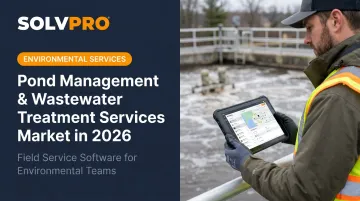
The pond management and wastewater treatment services market is no longer two separate worlds. Aquatic ecosystem maintenance, municipal effluent treatment, and water quality compliance are converging into a single, faster-moving service category heading into 2026.
Regulators want cleaner discharge. Property owners want healthier lakes and ponds without a chemical footprint. And technology is making both goals easier to hit at the same time.
Yet keeping pace with these changes isn't easy for every operator. Permit requirements shift, customer expectations rise, and multi-site contracts add mounting administrative work. Growth can easily outpace a business's ability to manage it all.
This article breaks down the trends driving both sectors in 2026, what's fueling them, and what service business owners need to watch to stay competitive.
TL;DR
- Wastewater treatment services are projected to reach $92.74 billion by 2030, a 6.87% CAGR from 2025
- Lake and pond management is growing even faster, with 6.5%+ CAGR forecasts through 2030
- Sensor tech, IoT monitoring, and field service software are becoming competitive differentiators, not luxuries
- Bundled, comprehensive service contracts are replacing single-issue fixes across both sectors
- Consolidation among large players is pushing independents to modernize or lose ground
Key Trends Shaping the Pond Management & Wastewater Treatment Market in 2026
Five trends are reshaping how these businesses deliver service, price contracts, and stay profitable. Some are driven by regulation. Others are driven by customers who simply want cleaner water and less hassle.
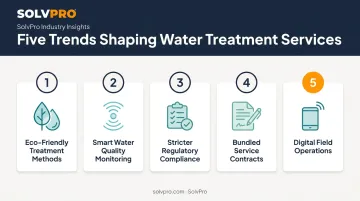
Trend 1: Rising Demand for Eco-Friendly and Sustainable Treatment Methods
Chemical algaecides aren't disappearing, but they're facing more scrutiny. Operators are shifting toward biological augmentation, native plant restoration, and low-impact aeration systems that address root causes instead of masking symptoms.
Regulatory pressure is part of the story. Washington State, for example, requires public notification and least-impact treatment selection before chemical applications near waterways, while California mandates NPDES permits and Aquatic Pesticide Application Plans for algaecide discharges.
This shift matters for revenue, too. The lake and pond management services market is projected to grow at a strong pace through 2030, with biological treatment identified as one of the fastest-growing service segments. Property owners aren't just accepting eco-friendly options anymore. Many are requesting them upfront.
Trend 2: Smart Water Quality Monitoring and Sensor Integration
Manual water testing is losing ground to IoT-enabled sensors that track dissolved oxygen, pH, and turbidity around the clock. Instead of a technician visiting a site to pull a water sample, the data streams in continuously.
The practical benefit is speed. A sensor network can flag an oxygen crash or an algae bloom hours before it would show up on a routine visit schedule, giving crews time to respond before a client calls with a complaint.
This isn't a niche upgrade. Operations and process control now represents 30.4% of U.S. wastewater treatment service value, the single largest service-type segment in the market.
On the pond side, the EPA has expanded its Cyanobacteria Assessment Network from monitoring roughly 2,200 large lakes to covering more than 270,000 U.S. lakes using satellite data. Remote monitoring is becoming the baseline, not the exception.
Trend 3: Stricter Regulatory Compliance Driving Service Demand
NPDES permits, EPA effluent guidelines, and state water quality standards are pushing both municipalities and private property owners toward professional service providers rather than DIY treatment.
The EU offers a clear preview of where U.S. policy may be headed. Directive (EU) 2024/3019, in force since January 2025, expands wastewater collection and treatment requirements down to agglomerations of just 1,000 population equivalent.
The directive also adds tertiary and quaternary treatment obligations, requiring pharmaceutical and cosmetics producers to fund up to 80% of micropollutant treatment costs.
In the U.S., municipal end-use already holds the largest share of wastewater treatment service value globally. As permitting complexity grows, more property owners are hiring specialists instead of managing compliance in-house.
Trend 4: Shift Toward Comprehensive, Bundled Service Contracts
Single-function treatments, algae control here, weed removal there, are giving way to full-service packages. One vendor now handles aeration, weed management, fish stocking, and shoreline restoration under a single contract.
Golf courses and HOAs are leading this shift. Golf courses alone accounted for roughly 21% of 2024 lake and pond management spending, a segment where year-round, multi-service contracts are the norm rather than the exception.
Clients want one invoice and one point of contact. That preference is reshaping how service providers structure pricing, scheduling, and crew assignments across a growing list of service lines.
Trend 5: Digital Transformation in Field Operations and Crew Management
Managing a handful of ponds with a notebook is one thing. Managing 60 sites across three counties with recurring contracts is another problem entirely.
Companies are adopting scheduling, dispatch, and mobile reporting tools to keep crews accountable and clients informed. Digital work orders with geolocation tracking eliminate the guesswork around whether a site actually got serviced this week.
Platforms like SolvPro let growing pond and water treatment businesses:
- Track job profitability across recurring maintenance contracts
- Automate invoicing the moment a technician marks a job complete
- Manage multiple crews from one scheduling calendar instead of five disconnected tools
As service volume grows, paper-based reporting stops scaling. Missed visits and billing delays start eating into margins that bundled contracts were supposed to protect.
What's Driving These Trends
A mix of environmental, economic, and regulatory forces is accelerating change across both sectors. With wastewater treatment services growing at a 6.87% CAGR and lake and pond management close behind, the underlying pressures are worth breaking down.
- Technology advances: AI-driven water analytics, automated dosing systems, and IIoT sensors are making continuous monitoring affordable for mid-size operators, not just large utilities
- Rising demand and customer expectations: Urbanization and growing recreational use of man-made lakes and ponds are expanding the client base for both residential and commercial water management
- Cost pressures: Rising labor and chemical costs are pushing operators toward efficient routing, bundled pricing, and software-driven scheduling to protect margins
- Regulatory influence: Rules like the Concentrated Aquatic Animal Production Effluent Guidelines (40 CFR Part 451) set technology-based discharge standards for larger aquaculture facilities, feeding directly into NPDES permit requirements
- Competitive consolidation: SOLitude Lake Management's 2022 acquisition of Clarke Aquatic Services added nearly 50 professionals across 59 offices in 41 states, while The Lake Doctors has built its own network of regional partnerships since 2021. Independents feel this pressure directly.
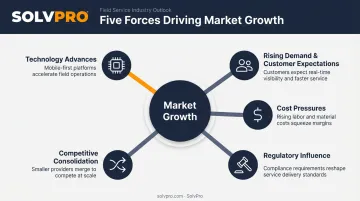
None of these forces operate in isolation. A municipality facing stricter discharge rules needs better monitoring technology, which in turn requires skilled technicians — and those technicians need software that doesn't waste their time on paperwork.
How These Trends Are Impacting the Industry
These shifts are changing how service businesses operate day to day, not just how they market themselves.
Operational Impact
Routine testing and treatment scheduling are moving from manual logs to mobile-first digital workflows. That shift reduces missed visits and creates cleaner documentation for compliance audits, something regulators now expect.
Bundling multiple services into one contract also raises the stakes for job costing. Without phase-based estimating, it's easy for a shoreline restoration add-on to quietly erode the margin on an otherwise profitable aeration contract.
Business Impact
To compete with better-funded consolidators, operators are investing in tools that used to feel optional:
- Monitoring and treatment-tracking systems
- CRM platforms for recurring maintenance contracts
- Field service software such as SolvPro for scheduling, job costing, and invoicing in one place
Compliance-driven demand is also creating steadier revenue: annual maintenance contracts are replacing one-off service calls as the default business model.
Workforce Impact
Technicians increasingly need skills in both aquatic biology and digital tools, an unusual combination that's pushing training budgets upward. At the same time, software adoption is reducing the administrative burden on office staff.
That's a meaningful trade. Time once spent on scheduling calls and paper invoices can go toward customer relationships and landing new contracts instead.
Future Signals for the Pond Management & Wastewater Treatment Market
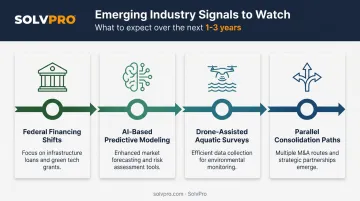
Expect these shifts to keep accelerating over the next one to three years. A few early indicators are worth tracking closely:
- Federal financing shifts: The Clean Water State Revolving Fund provided more than $8.8 billion in financing in 2023 alone, with billions historically directed toward septic-to-sewer conversions and onsite treatment upgrades.
- AI-based predictive modeling: Water utilities are actively researching generative AI applications for use-case development, risk assessment, and operational best practices.
- Drone-assisted aquatic surveys: Industry conferences are already featuring cost-benefit analyses of drone mapping for invasive plant detection and hard-to-access vegetation control.
- Parallel consolidation paths: Expect continued acquisitions by large players alongside a rising class of tech-enabled independents who compete on service quality and responsiveness rather than scale.
The businesses that win in this next phase likely won't be the biggest ones. They'll be the ones that pair sound water science with operational systems that don't buckle under growth. Platforms like SolvPro make that discipline easier by keeping scheduling, job costs, and crew accountability in one system as service volume grows.
Conclusion
Eco-friendly treatment methods, smart monitoring, tighter regulation, bundled contracts, and digital field operations are reshaping this market as interconnected forces. Each trend feeds the others.
Businesses that adapt early will hold a real edge as demand grows through 2026 and beyond. That means adopting sustainable practices while also modernizing how they schedule, invoice, and track crews.
Strategic awareness matters, but it only goes so far without the operational tools to back it up. Platforms like SolvPro help growing service businesses run recurring contracts, track job profitability, and keep crews accountable—without adding another layer of complexity to an already busy day.
Frequently Asked Questions
What is driving growth in the pond management and wastewater treatment services market?
Urbanization, water scarcity, and stricter discharge regulations are expanding demand across both sectors. Rising recreational and aesthetic interest in managed lakes and ponds is adding further momentum, particularly among HOAs and commercial properties.
How big is the wastewater treatment services market expected to be by 2030?
The market is projected to reach $92.74 billion by 2030, growing at a 6.87% CAGR from 2025 to 2030. Municipal end-use and operations/process control services represent the largest share of that value.
What is the difference between lake and pond management services?
Lakes typically serve larger recreational or drinking-water functions, while ponds are more common on private and commercial properties. Service methods, including algae control, aeration, and water testing, overlap between the two.
Are eco-friendly pond treatments as effective as chemical treatments?
Biological and integrated treatments are increasingly effective, especially when paired with consistent monitoring. Results may take longer to appear than with chemical methods, but the long-term ecosystem balance tends to be more stable.
How is technology changing pond and wastewater treatment services?
IoT sensors now track water quality continuously instead of relying on periodic manual testing. Automated dosing systems and field service software are also improving response times and reducing unnecessary site visits.
What software tools help pond management and wastewater treatment businesses run more efficiently?
Field service platforms like SolvPro help operators schedule recurring maintenance visits, track crew accountability through geolocation, and speed up invoicing across multiple sites. This reduces the administrative load that typically slows growth.