Introduction
Type "CRM" into Google and you'll get a flood of results about Customer Relationship Management — Salesforce, HubSpot, sales pipelines. But there's another CRM that predates all of that software by decades: Crew Resource Management.
It started in aviation as a response to preventable crashes caused by poor communication in the cockpit. Today, those same principles show up in how hospitals run trauma teams and how firefighters coordinate on a burning structure.
Field service crews face the same stakes. When jobs are scattered across multiple sites, a single missed handoff can derail the schedule and cost real money.
This guide covers where CRM came from, its core skills, and how those ideas have evolved into modern crew management software. That includes tools built for construction, landscaping, plumbing, and other service businesses running distributed teams every day.
Key Takeaways
- CRM began in aviation to reduce human error through better crew communication
- No official CRM framework exists; most cite 5-7 skills, led by communication
- United launched the first CRM training program in 1981, after a 1978 crash
- Those principles now power crew management software for field service teams
What Is Crew Resource Management (CRM)?
The U.S. Navy defines CRM as "the effective use of all available resources by individuals, aircrews, and teams to safely and efficiently accomplish a mission or task" while identifying and managing conditions that lead to error. It's a mouthful, but the idea is simple: no single person, no matter how skilled, catches every mistake alone. Teams do.
Where the Idea Came From
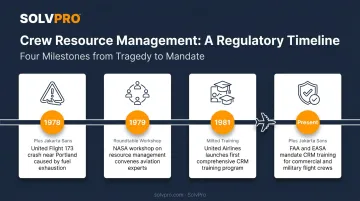
CRM's roots trace to a NASA-hosted workshop called "Resource Management on the Flight Deck," held in San Francisco from June 26-28, 1979. Sixty-five attendees from countries including the U.S., U.K., Japan, and Australia gathered there.
A troubling pattern had emerged in accident investigations: crews weren't failing because of flying skills. They were failing because of poor communication, weak leadership, and breakdowns in decision-making.
NASA's John Lauber co-chaired the event alongside Pan Am's Captain A.A. Frink. The workshop's findings pointed to one consistent theme — ineffective use of available crew resources was a major factor in accidents. Their recommendations included formal training in crew coordination, complete-crew (not just pilot) training, and regular simulator practice.
The Crash That Forced the Industry's Hand
The urgency behind CRM has a specific origin point: United Airlines Flight 173. On December 28, 1978, the flight crashed near Portland after running out of fuel, while the crew was fixated on a landing gear problem. Of 189 people aboard, 10 died.
The NTSB's investigation found the captain failed to monitor the fuel state, but just as damning: other crew members noticed the problem and didn't push hard enough to make him listen. The report described it plainly as a breakdown in cockpit teamwork.
That finding led directly to Safety Recommendation A-79-47, which urged the FAA to train flight crews in resource-management principles, specifically pushing captains toward participative leadership and other crew members toward assertiveness. United Airlines responded by launching the first comprehensive airline CRM training program in 1981.
The impact was lasting. CRM training is now required for Part 121 airline crews under 14 CFR 121.404, for Part 135 operators under 135.330, and mirrored in Europe through EASA's Part-ORO regulations. A single 1978 crash reshaped how the entire aviation industry trains its crews.
The Core Elements of Crew Resource Management
Search "5 elements of CRM" and you'll find plenty of tidy lists. Here's the catch: there's no single official 5-element standard. The U.S. Navy's current CRM instruction actually names seven critical skills. Most other summaries condense these into five for simplicity. Here's the commonly cited breakdown:
- Decision Making: Choosing a course of action based on logic and available information, not rank or gut instinct.
- Situational Awareness: Maintaining an accurate, real-time picture of the environment, the team, and emerging risks.
- Communication: Sending, receiving, and confirming information clearly, including active listening and requested feedback.
- Leadership & Assertiveness: Directing a team while empowering every member to speak up, even to someone senior.
- Adaptability & Mission Analysis: Planning ahead, then adjusting the plan as new information changes the picture.
A Real Example of These Skills Working Together
On July 19, 1989, United Airlines Flight 232 suffered a catastrophic engine failure that knocked out all three hydraulic systems on the DC-10 — a failure the aircraft wasn't designed to survive. The captain brought an off-duty check airman into the cockpit to help manage the controls manually, since normal steering was gone.
The NTSB's investigation called the captain's decision to add that extra set of hands prudent, and described the crew's overall performance as exceptional, beyond what could reasonably be expected. Of 296 people aboard, 185 survived a crash that, by every mechanical standard, should have killed everyone. No single pilot could have pulled that off. It took a coordinated crew applying nearly every CRM skill at once.
Essential Tools and Techniques CRM Provides
CRM isn't taught through lectures alone. It's reinforced through structured habits that make the skills stick.
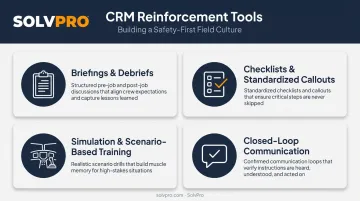
- Briefings and debriefs: FAA guidance calls for CRM concepts to be addressed before and after training sessions, building a habit of reviewing what worked and what didn't.
- Checklists and standardized callouts: Shared reference points, like a stabilized approach checklist, give anyone on the crew explicit permission to flag a deviation, regardless of seniority.
- Simulation and scenario-based training: Recurring practice in full-mission simulators (what the FAA calls LOFT) keeps CRM skills sharp, the same way any skill needs regular reps.
- Closed-loop communication: Messages get sent, received, and confirmed back, closing the gap where critical information tends to get lost, a core habit built into tools like AHRQ's TeamSTEPPS.
Plenty of organizations have taken these same habits (briefings, checklists, communication logs) and moved them into digital tools. Field service businesses managing crews across multiple job sites are doing exactly that right now.
From Cockpit to Job Site: Applying CRM Principles to Field Service Crews
Why Field Service Crews Need CRM Thinking
Jobs fall apart for the same reason flights sometimes do: the people who need to talk to each other, don't. A crew shows up to a job site without the right materials because nobody confirmed the scope change from yesterday. A plumber notices a problem but doesn't flag it because the last three times he raised concerns, nobody acted on them.
This is a systems problem, not a personnel one, and it's the same problem CRM was built to solve.
- Situational awareness means knowing crew location, job status, and material needs in real time, not discovering at 4 PM that a crew has been stuck without parts since 10 AM.
- Assertiveness and accountability mean crew members flag problems instead of staying quiet, the same silent deference that has caused costly errors in both cockpits and construction sites.
- Clear communication channels replace informal chains of information with defined paths, so updates reach the right person immediately instead of getting lost between calls and texts.
What to Look for in Crew Resource Management Software for Service Businesses
Once you accept that field crews face the same communication gaps pilots faced in 1978, the software checklist becomes obvious. Look for platforms that build these CRM principles directly into daily operations:
Real-time, two-way communication. Replace scattered phone calls and paper work orders with a single source of truth. Crews should see job scope, notes, and instructions on any device; the office should see job status update the moment work starts or finishes, with no chasing anyone down.
Event-based geolocation tracking. This is the field service equivalent of a black box. SolvPro's platform geo-stamps time entries, photo uploads, and activity logs the moment they happen, not continuous tracking, just verified proof at the moments that matter. That means accountability without a supervisor standing on every site, included across every pricing tier at no added cost.
Centralized scheduling and work order visibility. A shared drag-and-drop calendar with day, week, and crew views gives dispatchers and field teams the same operational picture. That visibility reduces the double-bookings and missed appointments that happen when scheduling lives in someone's head or a spreadsheet.
Job-costing and profitability visibility. Every completed job deserves a post-mission review. Real-time labor and material tracking, synced to QuickBooks Online, shows office staff exactly what a job earned versus what it cost, catching margin problems before they repeat on the next ten jobs.
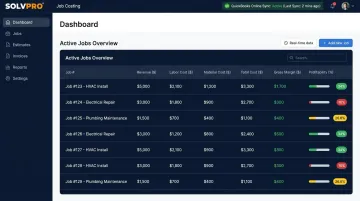
Platforms built specifically for growing service businesses, SolvPro among them, translate these CRM-inspired habits into tools crews will actually use, without the multi-week implementation and steep learning curve that comes with enterprise systems built for entirely different industries. Setup takes under 10 minutes, with a live team walking new users through onboarding instead of a chatbot or 40-page manual.
Frequently Asked Questions
What is crew resource management (CRM)?
CRM is a training approach focused on communication, decision-making, and teamwork, designed to reduce human error on high-stakes teams. It began in aviation and has since spread to healthcare, firefighting, and field service operations.
What are the 5 elements of crew resource management?
Commonly cited pillars include communication, situational awareness, decision making, leadership/assertiveness, and adaptability. Official frameworks, like the U.S. Navy's, list up to seven distinct skills.
What tools does crew resource management provide?
CRM relies on structured tools: preflight briefings and post-flight debriefs, standardized checklists and callouts, simulation-based training, and closed-loop communication protocols where messages are confirmed, not assumed.
Which airline developed crew resource management (CRM)?
United Airlines launched the first comprehensive CRM training program in 1981, following NTSB recommendations tied to the 1978 Flight 173 fuel-exhaustion crash near Portland.
Is CRM training required by law?
Yes. The FAA requires CRM training for Part 121 and Part 135 flight crews, EASA mandates it for European operators, and military aviation programs require it as well.
Can crew resource management principles apply to industries outside aviation?
Absolutely. Healthcare uses a CRM-based framework called TeamSTEPPS, fire departments have adapted it since 2002, and field service businesses now apply the same thinking through dedicated crew management software.