Most software built for nonprofits only serves one engine. It tracks donations beautifully but has no idea how to schedule a crew, issue a work order, or track who showed up to a rebuild site last Tuesday.
This guide breaks down the best CRM options for nonprofit contractors—covering donor-focused platforms, field-operations tools, and how to figure out which category (or combination) your organization actually needs.
Key Takeaways
- Nonprofit contractors need two systems: donor management plus field scheduling and crew tracking
- Donor CRMs (Bloomerang, Neon CRM, Salesforce) handle fundraising well but skip crew management
- Field service platforms like SolvPro cover scheduling, work orders, and crew accountability
- Your biggest bottleneck, whether fundraising or field management, should drive your first purchase decision
- Prioritize integrations, bilingual support, and transparent pricing when comparing vendors
What Makes CRM Needs Different for Nonprofit Contractors
A "nonprofit contractor" isn't a formal industry term, but you know one when you see it: a charity that combines a mission with hands-on construction work. Home repair, weatherization, disaster rebuilding, accessibility retrofits. Organizations doing this work often rely on a blend of volunteer labor and paid trade crews.
That mix creates a software problem. These groups sit right at the intersection of two entirely different categories:
- Donor/constituent management: built for stewardship, campaigns, and fundraising
- Field service/job management: built for scheduling, dispatch, and crew accountability
Most vendors pick a lane and stay in it. A traditional nonprofit CRM handles donor segmentation and giving history but has no concept of a work order or a crew calendar.
The Scale Problem Is Real
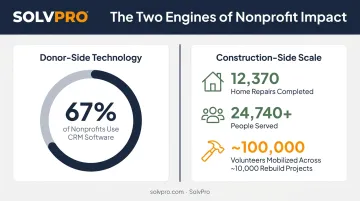
This isn't a niche issue. 67% of nonprofits already use CRM software to track donations and manage communications, according to the 2023 Nonprofit Tech for Good Report, which surveyed nonprofit professionals across 116 countries.
Meanwhile, the construction-style side of the sector is massive on its own:
- Habitat for Humanity completed 12,370 U.S. home repairs in FY2025, serving more than 24,740 people, per its FY2025 Annual Report
- Rebuilding Together's affiliates mobilize nearly 100,000 volunteers to finish close to 10,000 rebuild projects annually
That's tens of thousands of field jobs happening alongside donor campaigns, often coordinated with spreadsheets and sticky notes because no single tool covers both sides. The list below includes donor-focused CRMs and field-operations platforms, so you can find your best fit, whether that's one tool or two working together.
Top CRM Software for Nonprofit Contractors
We evaluated each platform on donor/volunteer management strength, field operations capability, ease of use, integrations, and pricing transparency.
SolvPro
SolvPro is a field service management platform built by a team with real construction, estimating, and project management backgrounds, not just software backgrounds. That matters for nonprofit contractors because the platform was shaped by people who've lived the chaos of double-booked jobs and lost paperwork on actual job sites.
For nonprofit programs running repair crews, disaster rebuilds, or volunteer construction days, a few features stand out:
- Bilingual English/Spanish interface across web and mobile, covering office admins, crew leads, and field crews alike
- Event-based geolocation tracking, which geo-stamps time entries and photo uploads so office staff know when and where work actually happened
- Phase-based estimating with client-facing PDF proposals, breaking a rebuild into stages like demo, rough-in, and finishing
- QuickBooks Online sync built into the core platform, not sold as an add-on
- Setup in under 10 minutes, with no long-term contracts and free live onboarding support
| Category | Details |
|---|---|
| Best For | Nonprofits managing field crews, home repair programs, or construction-based charitable projects |
| Key Features | Job scheduling, work orders, crew tracking, bilingual support, QuickBooks sync |
| Pricing | Transparent SMB-friendly pricing starting at $179/month for up to 3 users; no long-term contracts, cancel anytime |
The tradeoff: SolvPro isn't built for donor stewardship or grant tracking. It's meant to run alongside a donor CRM, handling the field-operations half most nonprofit software ignores.
Bloomerang
Bloomerang is built for donor retention. Its Constituent Dashboard tracks donor cultivation, acquisition, and retention with classifications for retained and recaptured givers, and its Donor Engagement Surveys score satisfaction, trust, and commitment over time.
It's a strong fit for organizations whose biggest gap is keeping donors engaged year over year. What it doesn't do: scheduling, dispatch, or anything resembling a work order.
| Category | Details |
|---|---|
| Best For | Nonprofits prioritizing donor retention and fundraising growth |
| Key Features | Donor profiles, engagement scoring, email marketing, online giving |
| Pricing | Starts around $125/month (billed annually), scaling with contact volume |
Salesforce Nonprofit Cloud
Salesforce Nonprofit Cloud is the most customizable option on this list. Built on the broader Salesforce ecosystem, it supports program and service data, enrollment tracking, and outcome measurement natively.
The catch: getting it to handle contractor-style job management usually means custom configuration or a consultant. That's a real resource ask for a smaller nonprofit contractor team without dedicated IT staff.
| Category | Details |
|---|---|
| Best For | Larger nonprofits with technical staff or an implementation budget |
| Key Features | Customizable dashboards, program management modules, AI-driven insights |
| Pricing | Starts around $60/user/month (Enterprise tier, billed annually), plus configuration and consulting costs |
Neon CRM
Neon CRM handles donor segmentation and program tracking with an interface that's easy for growing nonprofits to pick up. Volunteer management is available as an add-on (roughly 10% of the base subscription) covering shifts, timesheets, and a self-service portal.
What it lacks is any native scheduling or work-order system for repair or construction programs. Volunteer shift tracking isn't the same as dispatching a crew to a job site.
| Category | Details |
|---|---|
| Best For | Growing nonprofits needing membership and program tracking |
| Key Features | Donor/volunteer profiles, email marketing, grant tracking |
| Pricing | Starts around $99/month, based on organizational revenue rather than contact count |
Virtuous
Virtuous focuses on automating and personalizing the donor journey: behavior-triggered emails, wealth and capacity insights, and campaign dashboards that mid-sized teams can run without a dedicated analytics staffer.
Like the other donor CRMs here, it doesn't extend into job costing, crew dispatch, or field work orders. It's a fundraising automation tool, full stop.
| Category | Details |
|---|---|
| Best For | Mid-sized nonprofits wanting automated donor communications |
| Key Features | Responsive fundraising framework, wealth insights, campaign reporting |
| Pricing | Custom quote required; no public pricing listed |
How to Choose the Best CRM for Your Nonprofit Contractor Organization
The most common mistake? Picking a CRM based purely on its fundraising reputation, then discovering three months into a rebuild season that nobody can track which crew is where.
Before you shortlist vendors, map out both sides of your operation separately:
- Document your fundraising workflow: donor touchpoints, campaign cadence, grant reporting requirements
- Document your field workflow: how jobs get assigned, how crews report status, how work orders move from estimate to completion
- Identify where the pain actually is: most organizations find one side is far more broken than the other
From there, a few evaluation factors matter more than feature checklists:
- Integrations first. Look for QuickBooks and payment processor sync so your fundraising and field-operations data don't require duplicate manual entry.
- Bilingual and mobile support. If your crews include Spanish-speaking volunteers or paid trades workers, a platform that only works in English on desktop is a nonstarter.
- Onboarding support. Nonprofits often run lean on administrative staff. Ask vendors directly what onboarding looks like: a self-service knowledge base, or a live person walking your team through setup.
- Request demos from both categories. Even if you're leaning toward a donor CRM, seeing a field-operations platform demo helps you understand what you'd be missing.
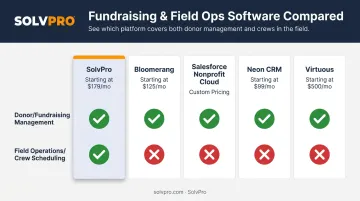
Few platforms cover both fundraising and field operations natively. Plan on pairing tools instead: a donor CRM for fundraising, paired with a field-operations platform like SolvPro to handle crew scheduling, job costing, and QuickBooks-synced invoicing.
Essential Features Checklist for Nonprofit Contractor CRMs
Use this checklist when comparing vendors, whether you're evaluating one platform or two.
Donor and volunteer management essentials:
- Contact profiles with complete giving history
- Donor segmentation for targeted campaigns
- Communication tracking across email, calls, and events
- Volunteer sign-up and hour logging
Field-operations essentials:
- Job scheduling with crew availability visibility
- Digital work orders with photo and note attachments
- Crew accountability tools, including geolocation tracking
- Job costing visibility covering labor and material costs
Integration and usability essentials:
- Accounting software sync, particularly QuickBooks Online
- Built-in payment processing for invoicing
- Mobile access for field crews and volunteers
- A low learning curve—critical for volunteer-run teams with high turnover
If a platform is missing more than one item from the field-operations list, it's likely a donor CRM wearing a "nonprofit CRM" label. That's fine, as long as you know you'll need a second tool for job management.
Conclusion
Nonprofit contractors have a dual-sided software problem that most single-category CRMs simply don't solve. Donor platforms like Bloomerang, Neon CRM, and Virtuous excel at fundraising but stop at the job site door. Field service platforms fill that gap, but they don't manage donor relationships.
Before committing to any platform, figure out where your organization's biggest operational gap actually lies: fundraising or field management. Don't be afraid to pair two tools if that's what your programs need.
If crew scheduling, work orders, and job accountability are the missing piece for your rebuild programs or repair crews, SolvPro is worth a look alongside whatever donor CRM you're already running.
Frequently Asked Questions
What is the best CRM for nonprofit contractors?
It depends on your primary need. Bloomerang or Neon CRM work well for donor management, while SolvPro handles field crew scheduling, work orders, job tracking, and invoicing. Many organizations pair a donor CRM with a field service platform.
Is there a free CRM for nonprofit contractors?
Free options like HubSpot's free tier or CiviCRM (used by more than 14,000 nonprofits) offer basic donor tracking. Neither includes field service features, so crews still need a dedicated tool like SolvPro for scheduling and job management.
What's the difference between a nonprofit CRM and a field service CRM?
Nonprofit CRMs focus on donor stewardship, fundraising, and communications. Field service CRMs like SolvPro focus on scheduling and crew accountability. They're complementary, not competing, categories.
Can nonprofit contractors use QuickBooks with their CRM?
Yes. Several platforms, including SolvPro, offer built-in QuickBooks Online sync covering job costing, labor tracking, and invoicing, so no separate bookkeeping software is required.
Do nonprofit CRMs support volunteer and paid crew scheduling?
Most traditional nonprofit CRMs weren't built for crew scheduling. Organizations running construction or repair programs typically need a dedicated field service tool for dispatch and job tracking.
How much does CRM software cost for a small nonprofit contractor organization?
Donor CRMs generally start between $99 and $125 per month. Field service platforms like SolvPro start around $179/month for small teams. Request transparent pricing during any demo before committing.