Introduction
Vehicle and equipment costs eat up roughly 8% (plus or minus 2%) of revenue for a typical landscaping or lawn care business, according to industry benchmarks reported by Lawn & Landscape. That number includes fuel, depreciation, insurance, and repairs.
Here's what that means on the ground: every extra 15 minutes of windshield time per truck per day is a stop you didn't make. Multiply that across five crews and a 30-week season, and you're looking at real margin loss, not a rounding error.
Fuel and drive-time costs are part of running a field-based business. That part's unavoidable. But excessive costs? Those usually trace back to decisions, missing visibility, or growth nobody managed carefully.
This article breaks down how these costs build up and three categories of fixes: decisions, day-to-day management, and business context.
TL;DR
- Fuel and drive-time costs add up gradually, minutes at a time, not as one lump sum
- Route density, dispatch method, crew fit, and seasonal swings drive most of these costs
- Fixes fall into three buckets: upfront choices, daily management, and structural changes
- Platforms combining scheduling, crew visibility, and dispatch, like SolvPro, help control these costs without added overhead
How Fuel and Drive-Time Costs Build Up in Landscaping Operations
These costs rarely show up as a single line item. They accumulate a few minutes at a time, per stop, per truck, per day. A crew running five minutes late to every stop doesn't notice much on Monday. By Friday, across 25 stops, that's over two lost hours.
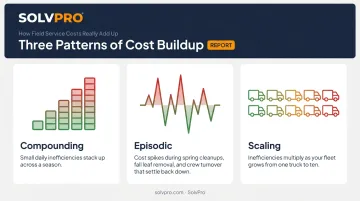
The buildup happens three ways:
- Compounding — Small daily inefficiencies stack across a season. One inefficient route multiplied by 150 working days adds up fast.
- Episodic — Costs spike during spring cleanups, fall leaf removal, fuel price jumps, or crew turnover, then settle back down.
- Scaling — What's invisible with one truck multiplies fast once a fleet grows to three, five, or ten trucks running the same routes.
For a solo operator, this is barely noticeable. One truck, one route, minor inefficiencies that don't matter much.
That scaling effect is exactly what NALP has documented in its lawn care routing playbook:
Weed Man's Kansas City operation found that one truck can service roughly 400 customers in a dense territory, while the same customer count in a lower-density area requires two trucks to cover. That's not a rounding error. That's a whole extra vehicle, driver, and fuel bill.
Key Cost Drivers Behind Inefficient Landscaping Routes
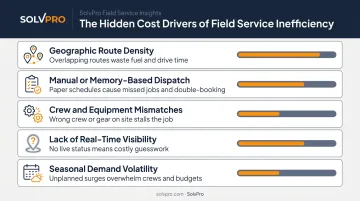
Not every landscaping business bleeds money the same way. The drivers below matter differently depending on your size and stage, but they all show up eventually. Here's how each one plays out in daily operations:
| Cost Driver | Why It Drains Money |
|---|---|
| Geographic Route Density | Scattered accounts cost more per stop than tightly clustered ones. NALP's guidance confirms tighter density cuts windshield time, so crews spend more of the day servicing properties instead of driving between them. Twenty stops packed into a five-mile radius will always beat twenty stops spread across 25 miles, even if both technically "finish the route." |
| Manual or Memory-Based Dispatch | Paper route sheets and verbal instructions create inconsistent sequencing, with no data behind the order, just habit. This is where avoidable backtracking sneaks in. |
| Crew and Equipment Mismatches | Sending a truck without the right mower, trailer, or license forces a choice: the crew improvises, or someone drives back for equipment. Either way, that's wasted miles and labor hours. |
| Lack of Real-Time Visibility | Without knowing where crews are or how a job is progressing, dispatchers can't react. Jobs run long, get canceled, or hit traffic, and the fixed plan keeps running regardless. |
| Seasonal Demand Volatility | Spring cleanups and fall leaf removal strain routes built for steady mowing volume. Lawn & Landscape's survey of roughly 220 companies found weather, labor shortages, and compressed service windows are consistent pain points during these surges. |
Bottom line: which driver matters most depends on where your business stands today. A solo truck's headaches look nothing like a six-truck operation's.
Cost-Reduction Strategies for Landscaping Route Optimization
Reducing routing costs looks different depending on where the fix actually happens: before routes are built, while they're running, or in the business structure surrounding them.
Strategies That Reduce Costs by Changing Decisions Made Before Routing
Get these right before the trucks leave the yard:
- Define a core service area boundary: Enforce it. Every new account outside that boundary scatters your map and drives up per-stop cost.
- Batch recurring services into fixed-day geographic zones: Weekly mowing and biweekly maintenance should be scheduled by zone and day, not purely by customer request.
- Set crew-to-equipment assignment rules at intake: Match the right truck, trailer, and license to the job before the day starts, not after a crew shows up without what they need.
- Price service calls to reflect drive-time cost: This discourages low-margin bookings far outside your territory.
Strategies That Reduce Costs by Changing How Routes Are Managed Day to Day
This is where software earns its keep.
Replacing manual sequencing with a system that auto-orders stops based on actual drive time removes the guesswork. RealGreen's Dynamic Routing case with Barefoot Grass Lawn Care is a useful example: route planning that previously took up to two hours per day dropped to roughly 20 minutes once software handled the sequencing (RealGreen's Dynamic Routing case study).
Beyond sequencing, day-to-day management should include:
- Real-time crew location and job status tracking: Dispatchers catch idle time, drift, or unauthorized detours as they happen. SolvPro builds this in through event-based geolocation tracking, tying location data to actual job events like arrival, start, and completion rather than just pinging a dot on a map.
- Job-level time and cost monitoring: Time tracking and job costing reports show which stops or zones are quietly eating into margin, so you're not finding out three months later.
- Mid-day route adjustments: When a job gets canceled, runs long, or weather hits, a drag-and-drop schedule lets a dispatcher reassign or reorder jobs in seconds instead of running a fixed plan regardless of what's happening in the field.
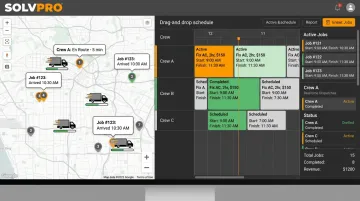
That last point matters more than it sounds. A fixed plan that ignores reality is just a guess with extra steps.
Strategies That Reduce Costs by Changing the Context Around Routing
Sometimes the real cost driver sits outside the route entirely, in the territory, fleet size, or growth pattern surrounding it.
- Market for density: Prioritize new customers inside existing route clusters instead of chasing scattered leads in new areas.
- Right-size the fleet: Match truck and equipment count to actual route demand. Under-trucking creates bottlenecks. Over-trucking burns cash on idle assets.
- Align crew scheduling with seasonal shifts: Don't run one fixed structure year-round when spring and fall demand look nothing like summer maintenance.
- Reassess far-flung accounts: Some low-density customers cost more to service than they're worth. Subcontract them out or let them go.
Conclusion
Cutting fuel and drive-time costs starts with correctly identifying where the cost originates. Is it a decision made before the route was built? A day-to-day management gap? Or a structural issue with territory and fleet size?
Guessing and cutting spend across the board rarely solves the underlying problem. Pinpointing the actual source and addressing it directly delivers lasting savings instead.
Effective cost reduction requires a strategic, continuous approach, especially as crews and accounts grow. Tools that combine real-time crew visibility with organized scheduling, like SolvPro, make it easier to sustain these gains without hiring extra office staff just to manage the chaos.
Frequently Asked Questions
What are the benefits of route optimization?
Route optimization reduces fuel and drive time while increasing billable stops per crew per day. It also improves customer ETAs and overall satisfaction by keeping schedules realistic.
What is the best route optimization software for landscaping businesses?
It depends on your size. Standalone routing tools work for basic sequencing, but growing multi-crew teams typically need a full field service platform bundling scheduling, crew tracking, and dispatch, such as SolvPro.
Can AI do route optimization?
Yes. AI-driven routing tools analyze stop locations, traffic, and job constraints to sequence routes automatically. RealGreen's Dynamic Routing case with Barefoot Grass Lawn Care cut route-planning time from up to two hours down to about 20 minutes.
How much can route optimization save a landscaping business in fuel costs?
According to RealGreen's lawn care routing analysis, companies moving to optimized routing typically see 10% to 20% reductions in fuel costs. That adds up fast across a full season.
Does route optimization make sense for a solo operator or small crew?
Not necessarily right away. Solo operators should focus on basic scheduling discipline first, then add optimization tools as truck count and accounts grow.
How do I start optimizing routes if I don't have software yet?
Start by mapping current accounts by zone, then batch recurring jobs by day and area. Move to dedicated scheduling and routing tools once manual tracking becomes too complex to manage by hand.