
What separates a profitable project from a disputed one is how that change gets handled. Without a defined process, change orders turn into scope creep, delayed payments, and margins that quietly disappear. That's especially painful for small crews and trade contractors who don't have a dedicated admin team tracking every verbal request.
This guide breaks down what change order management actually means, what belongs in a compliant change order, the step-by-step process to follow, and the habits that keep growing service businesses paid on time.
Key Takeaways
- Change order management tracks, prices, and approves shifts in scope, cost, or schedule.
- A valid change order includes scope details, itemized costs, and signatures before work begins.
- Per AIA's 2023 analysis of 18,229 projects, orders average 1.70 on jobs under $500K vs. 11.29 on jobs over $50 million.
- Either party can initiate a change, but the GC or PM usually manages documentation and approval.
- Field-based digital tools cut disputes and speed approvals, key for crews juggling multiple jobs.
What Is Construction Change Order Management?
Change order management is the systematic process of catching, documenting, pricing, negotiating, and formally approving any modification to a construction contract's original scope, cost, or schedule. This defined workflow protects both parties when the job doesn't go exactly according to plan.
A change order is a binding, mutually signed amendment to the contract. That's different from a work order, which just covers tasks already inside the agreed scope. If a task requires new pricing, added time, or a scope shift outside the original agreement, it needs a change order, not just a note in a work order.
This isn't only a large commercial GC problem. Electrical, plumbing, landscaping, and cleaning contractors deal with scope changes constantly on residential and commercial jobs, often with far less formal paperwork in place than a big general contractor would have. A landscaper adding a retaining wall mid-project or a cleaning crew picking up extra square footage both need the same discipline, just scaled to fit a smaller operation.
Change Order vs. Change Directive
These two terms get confused often, but they work very differently:
- Change Order (CO): Owner and contractor agree on scope, cost, and schedule before work begins. This is the standard, low-risk path.
- Change Directive (CD): The owner unilaterally orders work to continue before price or time is settled, often creating disputes once final costs are negotiated.
If you're a subcontractor or trade crew, treat any verbal instruction to "just get started, we'll figure out pricing later" as a red flag. That's a change directive in disguise, and it puts your payment at risk.
Common Causes and Triggers of Change Orders
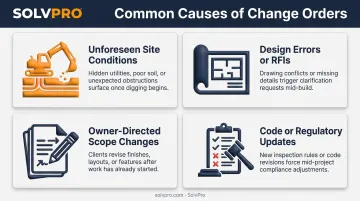
Most change orders trace back to a handful of recurring triggers:
- Unforeseen site conditions: hidden utilities, unexpected soil or rock, or structural surprises behind existing finishes
- Design errors or RFIs: gaps or conflicts in the original plans that surface once work is underway
- Owner-directed scope changes: the client simply wants something different than what was originally specified
- Code or regulatory updates: new inspection requirements or permit conditions that weren't in play at contract signing
Design and documentation errors are a bigger driver than most contractors assume. A 2025 USDOT Volpe Center report on Texas DOT projects (2001–2015) found they accounted for roughly one-fourth of change orders by count and one-third by value.
That's transportation-specific data, but the pattern holds broadly: bad plans cost real money downstream.
Not all triggers show up in the cost data, though. Scope creep deserves its own mention: a client makes an informal request mid-job, like "can you also patch that section while you're here," without anyone documenting it as a formal change.
It's one of the most preventable causes of margin loss, and it hits smaller trade contractors hardest. Without an admin team logging every conversation, verbal add-ons slip through unbilled and unprotected.
What Should Be Included in a Change Order?
A change order isn't a text message or a handshake. To hold up if disputed, it needs specific components documented in writing.
Project and contact information:
- Contract number and sequential change order number
- Owner and contractor details
- Project address
Scope and justification:
- A detailed narrative explaining exactly what's changing and why
- Reference to any originating RFI, proposed change order (PCO), or field discovery that triggered it
Cost breakdown:
- Labor, materials, equipment, and overhead/profit markup, itemized separately
There's no universal markup percentage to rely on. Under AIA A201-2017, overhead and profit must follow whatever's stated in the governing agreement, or a reasonable amount if the contract is silent. Don't assume a flat 10-15% applies; check your contract terms.
Schedule and proof:
- A schedule impact statement noting days added or removed, and whether it affects the critical path
- Supporting documentation: photos, sketches, revised drawings, or supplier quotes
Signatures:
- Owner, contractor, and any affected subcontractors, signed before work proceeds, never retroactively
Skip any one of these pieces and you're left arguing from memory instead of documentation when a dispute comes up.
The Change Order Management Process: Step by Step
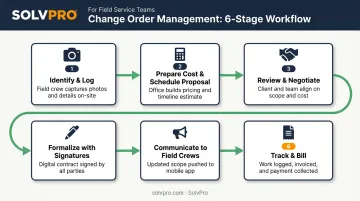
A change order moves through six distinct stages before it's fully resolved.
- Identify and log the change immediately. Capture photos, tag the location on drawings, and create a record the moment it's discovered. Waiting until the next scheduled meeting lets details get fuzzy.
- Prepare a detailed cost and schedule proposal. Include labor hours, material pricing, subcontractor quotes, and time impact before submitting for approval.
- Review and negotiate. Resolve disputes over labor rates, material costs, or schedule impact using supporting documentation rather than verbal assertions.
- Formalize with signatures. Get sign-off from all required parties, then update the contract sum and schedule of values.
- Communicate to field crews. Confirm the team executing the work understands the updated scope, budget, and schedule, then monitor to make sure execution matches what was approved.
- Track and bill. Log the change in a running change order log, then bill it on the next pay application. Don't let approved changes sit unbilled for months waiting for a "convenient" invoicing cycle.
That last step trips up more contractors than any other. An approved change order that isn't billed promptly is money sitting on the table, and the longer it sits, the easier it is to forget entirely.
Who's Responsible for Change Orders, and How to Manage Them Well
Either the owner or the contractor can initiate a change order. But the general contractor or project manager typically owns the responsibility for documenting it, pricing it, and routing it through approval. Subcontractors still need formal sign-off before starting any changed work — even if the request comes verbally from someone on-site.
Core best practices that prevent disputes:
- Never begin work without written approval, no matter how small the ask seems
- Calendar every contract notice deadline. These vary by agreement, so don't assume a generic window applies
- Maintain a single, up-to-date change order log visible to the whole team, not scattered across email threads and text messages
For crews without a dedicated admin team, this is where field service software earns its keep. SolvPro lets field crews log scope changes from the jobsite in real time, all inside the same digital work order the office is already tracking. Each entry captures:
- Photos and notes documenting the change
- Change order details tied to the original work order
- A geo-stamp confirming the location and time, verifying work matched the approved scope
That real-time visibility means the office isn't waiting for end-of-day paperwork to know a change happened, and job costing stays accurate as the scope shifts. For a small crew running lean (often just an owner, a foreman, and maybe one office contact), that kind of built-in documentation removes the admin burden that causes missed change orders and delayed payment.

Frequently Asked Questions
What is change order management in construction?
It's the process of documenting, pricing, negotiating, and formally approving any modification to a construction contract's scope, cost, or schedule. It applies to both large commercial builds and small trade jobs.
What should be included in a change order?
A compliant change order needs a scope description, itemized cost breakdown, schedule impact statement, supporting documentation like photos or quotes, and signatures from all parties before work begins.
Who is responsible for change orders?
Either the owner or contractor can initiate a change, but the GC or project manager typically manages documentation, pricing, and approval routing. Subcontractors still need sign-off before starting changed work.
What is the average percent of change orders in construction?
There's no single industry-wide percentage. AIA's 2023 analysis of completed projects found the average number of change orders rises sharply with project size — from 1.70 on jobs under $500K to 11.29 on jobs over $50 million.
What's the difference between a change order and a change directive?
A change order is mutually signed by owner and contractor before work begins. A change directive is issued unilaterally by the owner when time is critical and terms on price or schedule aren't yet agreed.
How long does change order approval typically take?
Timelines vary by contract, with some requiring notice within 14-21 days of an event. A GAO review of over 62,000 Army Corps of Engineers contract changes found about a third finalized within 30 days, while others took more than a year.