This happens constantly in field service businesses — HVAC, plumbing, landscaping, janitorial, general contracting. Not because crews don't care, but because nobody wrote down what "good service" actually looks like.
A service level agreement (SLA) fixes that. It's not just an IT concept for software uptime. Any service business with commercial clients or repeat customers can use one to set clear expectations and protect the relationship when things go sideways.
This guide covers what an SLA actually is, its core components, the three common types, and how to build one for your own service business.
Key Takeaways
- An SLA defines scope, performance standards, and responsibilities between provider and customer in measurable terms.
- Three common SLA types exist: customer-based, service-based, and multi-level.
- Missed SLA targets should trigger predefined remedies, not just an apology.
- Field service businesses can use SLAs to win larger commercial contracts, just like software vendors do.
What Is a Service Level Agreement (SLA)?
An SLA is a formal agreement between a service provider and a customer that spells out exactly what services get delivered, how performance will be measured, and what happens if targets aren't hit. It's specific. It's measurable. And it removes guesswork from the relationship.
The concept has roots in IT and telecommunications. The UK's Central Computer and Telecommunications Agency released the ITIL framework in 1989, and the ITU formalized a telecom SLA structure in 2002 covering quality-of-service parameters, responsibilities, and reporting. Cloud providers later adopted the same logic for uptime guarantees.
That same structure now applies directly to field service work. A janitorial company managing a retail chain's stores, an HVAC contractor servicing commercial rooftop units, and a landscaping crew maintaining a corporate campus are all making service promises that benefit from being written down and measured.
An SLA is not the same as a standard contract or quote. A contract sets general terms: price, duration, payment schedule. An SLA goes further by attaching specific, measurable performance targets to that relationship, such as response windows or completion deadlines.
Why SLAs Matter for Service Businesses
SLAs solve two problems at once: ambiguity and trust.
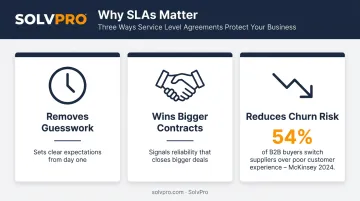
- They remove guesswork. When "we'll get to it soon" becomes "we respond within 4 business hours," clients know what to expect and providers know what they're accountable for.
- Bigger contracts follow. Property managers, retail chains, and facilities teams increasingly require a documented SLA before signing with a vendor — it's become a baseline expectation in commercial procurement, not a nice-to-have.
- Churn risk drops too. McKinsey's 2024 B2B Pulse survey of nearly 4,000 B2B decision-makers found that among those likely to switch suppliers, 54% cited poor-quality customer experience as the reason. Unclear service expectations are a direct driver of that experience gap.
Put simply: vague promises lose contracts. Documented ones win them.
Key Components of an SLA
A real SLA isn't a single paragraph about response times. It's built from several distinct pieces, and skipping any of them creates room for disputes later.
- Service description. Lists exactly what's covered, from specific maintenance tasks and cleaning frequency to electrical inspection scope, preventing scope confusion before it starts.
- Performance metrics and targets. Response time, resolution time, and quality standards, stated as specific numbers: "Respond within 4 business hours" works, "respond promptly" doesn't.
- Roles and responsibilities. What the provider delivers, and what the customer must provide in return: site access, a designated point of contact, timely payment.
- Exceptions and exclusions. Circumstances where targets don't apply: holidays, severe weather, delays caused by the customer.
- Remedies and penalties. What happens when a target is missed: service credits, discounts, or a formal contract review. This is what gives the agreement teeth.
- Review cadence and sign-off. A schedule for revisiting terms (quarterly or annually works for most service businesses) plus signatures from both parties to make it official.
Facilities management standards from groups like RICS treat these elements as standard practice in outsourced FM contracts. Cleaning-industry standards such as ISSA's CIMS require documented, site-specific scope and performance measurement. The pattern holds across industries: define it, measure it, put remedies in writing.
Types of SLAs
SLAs generally fall into three structures, depending on your business model and how many different client relationships you're managing.
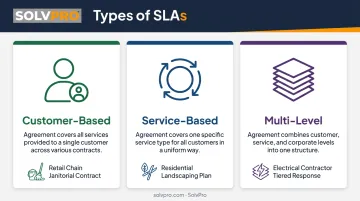
Customer-Based SLA
This type covers all services a specific customer receives, tailored to their particular needs. It's one agreement, built around one client relationship.
Example: A janitorial company creates a single SLA for a retail chain that covers every store location the chain operates, with consistent terms across all of them regardless of individual store size or foot traffic.
Service-Based SLA
This is a standardized agreement applied to every customer who receives a particular service, regardless of who they are. Everyone gets the same terms for that service.
Example: A landscaping company offers identical lawn-care response and completion terms to every residential client on its recurring maintenance plan, including the same mowing frequency guarantees and the same response window for service requests.
Multi-Level SLA
This structure layers company-wide baseline standards with additional customer-specific or service-specific terms on top. It's the most flexible option, and often the most realistic for growing businesses.
Example: An electrical contractor sets baseline response policies for all clients, then adds custom terms for large commercial accounts and separate tiers distinguishing routine maintenance from emergency repair calls.
Terminology varies slightly by source (some frameworks use "internal" instead of "service-based"), but the three-tier logic holds across most business contexts.
How to Create an SLA for Your Service Business
Building an SLA doesn't require a legal team. It requires honesty about your crew's actual capacity and a willingness to write things down.
- Define the exact scope of services. List specific tasks, service frequency, and what's explicitly excluded. Vague scope is the number one cause of disputes down the road.
- Set realistic, measurable targets. Base response and completion windows on what your crew can consistently deliver, not what sounds impressive in a sales pitch. RICS's facilities management guidance warns against 100% targets for high-volume work, since they inflate risk pricing without added value. Save near-perfect targets for compliance-critical work.
- Outline roles and an escalation path. Both sides need to know who to call when something goes wrong, not just what the target is.
- Define remedies and set a review schedule. Credits, discounts, or make-good visits for missed targets, plus a set cadence to revisit terms as your business grows.
A short, concrete example is worth more than paragraphs of explanation. Here's a sample excerpt for a field service SLA:
"Provider will respond to service requests within 4 business hours of receipt. Standard maintenance visits will be completed within 24 hours of the scheduled appointment. Emergency requests receive priority response within 1 hour."
For reference, Western Kentucky University's published facilities management SLA sets a 1-hour response and 24-hour completion window for critical work. Urgent work gets a 4-hour response with 48-hour completion, showing how these numbers play out in practice.
Delivering on What You Promise
Writing an SLA is the easy part. Actually hitting those targets, day after day, across multiple crews and job sites, is where most businesses struggle.
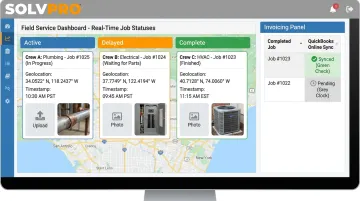
This is where field service management software earns its place. SolvPro gives office teams real-time visibility into which jobs are active, delayed, or complete, so nobody's guessing whether a 4-hour response window is at risk until a client calls to complain.
Event-based geolocation tracking geo-stamps time entries and photo uploads, creating a documented record of when a crew actually arrived and finished. That record supports internal accountability and gives clients proof you hit your numbers.
On the billing side, jobs marked complete in the field can trigger invoicing immediately, with QuickBooks Online sync eliminating the manual reconciliation step. That matters for SLA-bound work specifically: a contract that promises fast service but slow billing still frustrates commercial clients. Faster invoicing keeps the whole relationship, not just the response time, feeling reliable.
SLA Best Practices and Common Mistakes to Avoid
Most SLA failures come down to a handful of predictable mistakes.
- Don't overpromise. Response times your crew can't consistently hit backfire worse than skipping an SLA altogether; a broken promise erodes trust faster than an honest limit ever could.
- Review terms regularly. An SLA signed when you had two crews doesn't fit a business running six. Revisit terms as headcount, client base, and service capacity change.
- Communicate clearly, both directions. Field crews need to know the targets they're accountable to, just as clients do. SolvPro's real-time dashboards keep both sides aligned, not just at renewal time.
Frequently Asked Questions
What is an SLA for software?
A software SLA typically defines uptime guarantees, support response times, and remedies like service credits if a SaaS or cloud provider misses those targets. Cloud providers such as AWS and Google Cloud publish these terms publicly.
What are the three types of SLAs?
Customer-based (one agreement per client), service-based (standard terms per service type), and multi-level (baseline company terms layered with client- and service-specific details). See the Types of SLAs section above for examples.
What is an example of an SLA?
A cleaning or field service company might commit to responding within 4 business hours and completing standard maintenance within 24 hours of the scheduled visit. The sample excerpt earlier in this guide shows this structure in full.
What's the difference between an SLA and a regular contract?
A contract sets general terms of the business relationship, like price and duration. An SLA adds specific, measurable performance targets and defines consequences for missing them.
How do you measure SLA compliance?
You track compliance by comparing agreed metrics, such as response time or completion time, against actual performance data. Field service software with real-time job status tracking makes this far easier than manual logs.
What happens if an SLA is breached?
A breach usually triggers whatever remedy the agreement predefined — a service credit, a discount, or a formal contract review. Check your contract's remedy clause to know exactly what to expect if targets are missed.