Introduction
A vague or late cleaning invoice does more than delay a payment. It erodes trust with the client who's already questioning whether they got what they paid for.
That trust gap compounds a cash flow problem common in the cleaning industry: crews finish a job, and the invoice sits in someone's truck for a week before it reaches the client. That gap adds up fast when you're running multiple crews.
This guide breaks down invoice types, the details every cleaning invoice needs, a step-by-step creation process, a free downloadable template, and tips to speed up payment. Whether you're running a one-person house-cleaning operation or managing several janitorial crews, a repeatable invoicing process protects your bottom line.
Key Takeaways
- Match your invoice type (flat fee, hourly, recurring, itemized) to each job for clarity
- Complete, itemized details and clear payment terms prevent disputes and speed up approval
- Use a consistent template to cut admin time and errors as your crew count grows
- Send invoices fast and automate follow-ups to get paid sooner
Types of Cleaning Service Invoices
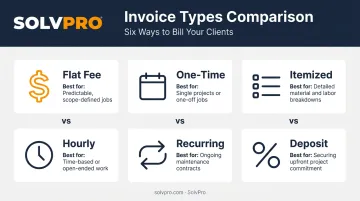
Your invoice format should mirror how you actually bill the job. A one-time deep clean needs a different structure than a monthly janitorial contract, and using the wrong format confuses clients and slows approval.
Flat Fee vs. Hourly Invoices
Flat fee (value-based) billing works best once you know how long jobs typically take. You quote one price for the entire job, regardless of how many hours it takes your crew.
- Preferred by established businesses with predictable job scopes
- Easier for clients to budget for and approve
- Protects your margin if the job goes faster than expected
- Simplifies invoicing since you bill per job, not per hour
Hourly billing is common for newer businesses still learning their average job times. It's lower-risk while you're still calibrating.
- Requires factoring in cleaner wages plus overhead, not just a guessed rate
- Rates vary by market: residential cleaners average $50 to $100 per hour per Forbes Home's 2024 provider survey, while commercial janitorial services run $28 to $50 per hour according to Cleaning & Maintenance Management's 2025 benchmark
Note the gap between what you charge and what you pay staff. The U.S. Bureau of Labor Statistics reports mean hourly pay of $17.83 for maids and housekeeping cleaners and $18.64 for janitors and cleaners — a useful wage floor when building your own rate, not a rate to charge clients directly.
One-Time vs. Recurring Invoices
One-time invoices cover single jobs like deep cleans and move-out cleans. Send these within 24 hours of service completion, while the work is still fresh in the client's mind.
Recurring/maintenance invoices fit contract clients like janitorial accounts and commercial buildings on a set schedule. Instead of billing after every visit, you consolidate multiple service dates into one monthly invoice.
- Simplifies bookkeeping for both you and the client's accounts payable team
- Aligns with Net 15/30 terms common in commercial contracts
- Reduces the number of invoices your office has to generate and track
Software like SolvPro can automate this consolidation, pulling completed job records into a single invoice each billing cycle.
Itemized & Deposit Invoices
Itemized invoices break down each task and its cost separately. If a job combines carpet extraction, window cleaning, and floor care, list them as distinct line items rather than one lump sum. This is standard practice for multi-service and commercial jobs where clients want to see exactly what they're paying for.
Deposit invoices request partial upfront payment before you start. Use these for:
- Large jobs requiring significant supply purchases
- Jobs with heavy labor commitments before you've built trust with a new client
- Move-out or post-construction cleans with tight scheduling risk
- Rush jobs booked on short notice, where cancellation risk is higher
What to Include in a Cleaning Service Invoice
A complete invoice answers every question a client might have before they even ask. Missing details are one of the most common reasons payments stall.
Business and client information:
Include your company name, logo, address, phone, email, and license or certification info if applicable. Add the client's name, service address, billing address (if different), and contact info.
Invoice identifiers:
Assign a unique invoice number for tracking and reference. Include both the invoice date and the actual service date(s), since they aren't always the same day.
The service breakdown:
Itemize each task with its own description and price. "Cleaning services: $250" tells a client nothing. "Kitchen deep clean: $85; Carpet extraction, 2 rooms: $60; Window cleaning, interior: $45" tells them exactly what they paid for and why.
Totals and terms:
- Subtotal, applicable sales tax, and total amount due, formatted in bold so it's impossible to miss
- Payment terms: due date, accepted payment methods, late fee policy
- An optional notes section for a thank-you message or job-specific detail
How to Create a Cleaning Invoice: Step-by-Step Process
Building a repeatable process matters more than any single invoice. Here's the sequence that keeps billing consistent as you scale.
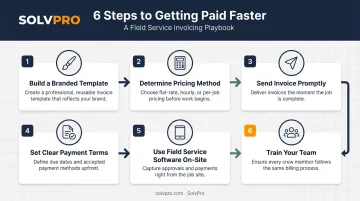
Build a branded template. Use the same logo, colors, and layout on every invoice so clients recognize your business instantly, whether it's job three or job three hundred.
Determine your pricing method. Decide flat fee versus hourly based on job predictability. Residential house cleaning averages $230 per visit (range: $60-$400+) per Forbes Home's survey, while commercial contracts often price per square foot instead of per hour.
Send the invoice promptly. Within 24 hours for one-time jobs. On a fixed cycle (weekly, biweekly, or monthly) for recurring commercial and janitorial contracts.
Set clear payment terms upfront. Due upon receipt, Net 15, Net 30, deposit requirements, whatever fits your business, but state it clearly and list every accepted payment method.
Use field service software to generate and send invoices on-site. This is where many cleaning businesses lose time. Platforms like SolvPro let crews create and send invoices from the job site on a phone or tablet. That data syncs with QuickBooks Online automatically, so your books stay accurate without manual re-entry.
Train your team on the same process. Office staff and crew leads should use one template, not five variations. Consistency here is what keeps billing errors from creeping in as you add crews and clients.
Free Cleaning Invoice Template & Example
A downloadable template saves you from rebuilding the same document every time. Look for one that's customizable enough to handle both a quick residential job and a detailed commercial contract. Field service platforms like SolvPro take this further, auto-populating these fields from your existing job and client records.
A good cleaning invoice template includes fields for:
- Business info and branding
- Client and service address details
- Itemized service lines with individual pricing
- Subtotal, tax, and total due
- Payment terms and accepted methods
Sample invoice breakdown:
| Line Item | Description | Price |
|---|---|---|
| Kitchen deep clean | Full appliance interior/exterior, cabinets | $85.00 |
| Carpet extraction | 2 rooms, stain treatment included | $60.00 |
| Window cleaning | Interior, 8 windows | $45.00 |
| Subtotal | $190.00 | |
| Sales tax (7%) | $13.30 | |
| Total Due | $203.30 |
Adjust the format depending on the invoice type covered earlier. A recurring janitorial account might list four weekly visits under one monthly invoice, while a deposit invoice would show the upfront amount separately from the final balance due.
Tips to Get Paid Faster & Avoid Common Mistakes
Getting paid faster usually comes down to habits, not luck.
Quick wins:
- Send the invoice the same day the job wraps, not three days later
- Offer multiple payment options: card, ACH, digital wallet
- Reference the invoice number on every payment to prevent mismatched records
Common mistakes that slow payment:
- Vague service descriptions ("cleaning — $200")
- Missing contact or business details
- Inconsistent pricing with no explanation for the difference
- Forgetting to apply sales tax
- No clear due date
The gap between finishing a job and actually getting paid is where most cleaning businesses lose momentum. SolvPro closes that gap with automated payment reminders and NMI payment processing built directly into the platform. Your crews won't need to manually chase overdue balances between jobs.
Frequently Asked Questions
How to invoice for a cleaning job?
List the services performed with individual prices, add a unique invoice number, and state your payment terms clearly. Send it within 24 hours using a consistent template or invoicing software.
How to get clients to pay invoices faster?
Send the invoice immediately after job completion, offer multiple payment methods like card and ACH, and use automated reminders for anything approaching or past due.
How much should a cleaner charge per hour?
Rates vary by region and service type. Residential cleaners in the U.S. typically charge $50 to $100 per hour, while commercial janitorial services run $28 to $50 per hour.
What should be included in a cleaning invoice?
Business and client info, a unique invoice number, itemized services with prices, subtotal and tax, total due, and clear payment terms with a due date.
How soon should I send a cleaning invoice after the job?
Within 24 hours for one-time jobs like deep cleans or move-outs. Recurring commercial and janitorial contracts are typically billed monthly instead.
What's the difference between a cleaning estimate and an invoice?
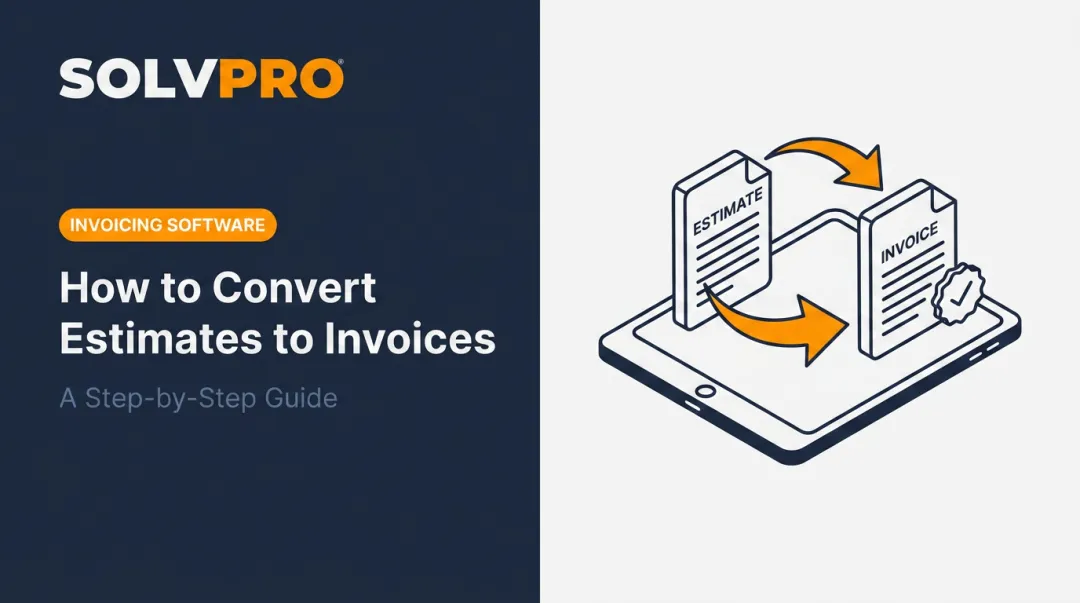
An estimate is a projected cost shared with the client before work begins. An invoice is the final bill sent after the job is complete, reflecting actual services performed.