Introduction
CRM adoption among small businesses is climbing fast. The global CRM market hit $79.6 billion in 2025 and is projected to reach $86.4 billion in 2026, growing at a 9.3% CAGR through 2033.
But "how much does a CRM cost" doesn't have one answer. A solo freelancer pays almost nothing. A five-person service crew struggling to juggle scheduling, invoicing, and customer records pays a lot more, especially when those tools live in separate apps.
This guide breaks down pricing tiers, hidden fees, and what service-based businesses specifically need to budget for in 2026.
Key Takeaways
- Monthly per-user CRM costs typically range from $9 to $100+, depending on tier and vendor.
- Automation, AI, and integrations drive prices up, while freemium and basic plans keep them low.
- Solo entrepreneurs and startups often start on free plans; multi-user teams with complex workflows pay far more.
- Service businesses juggling office and field work often spend less on one all-in-one platform than on separate CRM and scheduling tools.
How Much Does a CRM Cost for Small Business in 2026? (Pricing Overview)
CRM software doesn't have a fixed price tag. Costs shift based on pricing structure, plan tier, and how many people need access.
Three mistakes tend to blow up budgets fast:
- Underestimating per-seat scaling as the team grows from 3 to 8 users
- Missing onboarding and setup fees that aren't advertised on the pricing page
- Over-buying enterprise features nobody on a five-person team will ever touch
Understanding CRM Pricing Models
Not all CRMs charge the same way. Here's how the major models work:
- Per-user/per-month: Cost multiplies directly with headcount, so a 5-person team on a $25/user plan pays $125/month.
- Tiered plans (Basic/Pro/Enterprise): Core features like automation or reporting get locked behind higher tiers, so the "cheap" plan often can't do what you actually need.
- Freemium-to-paid: Fine for early-stage businesses, but the upgrade path gets expensive quickly once you hit user or record caps.
- Flat-rate/unlimited-user pricing: A fixed monthly fee covers a set number of seats, which works better for growing crews that want predictable costs instead of a bill that climbs with every new hire.
Typical Cost Ranges by Tier
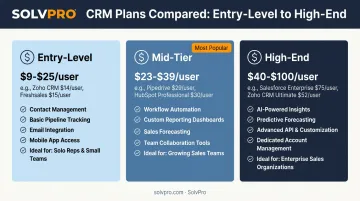
According to Capterra's 2026 CRM pricing report, average per-user monthly costs break down like this:
| Tier | Avg. Per-User/Month | What's Typically Included | Best For |
|---|---|---|---|
| Entry-level | $34.77 (vendor range: $9-$25) | Contact management, basic pipeline, email sync | Solo users, very small teams |
| Mid-tier | $64.58 (vendor range: $23-$39) | Workflow automation, reporting, integrations | Growing teams needing structure |
| High-end | $90.42 (vendor range: $40-$100) | AI insights, forecasting, advanced permissions | Multi-department or complex sales orgs |
The averages reflect Capterra's full surveyed vendor pool, while the ranges below highlight pricing from the specific providers named here.
For context, real vendor examples billed annually: HubSpot Starter runs $9/user, Zoho Standard $14, Pipedrive Lite $14, and Salesforce Starter $25 at the entry level. Mid-tier plans like Zoho Professional ($23) and Pipedrive Growth ($39) add automation depth. At the top, Salesforce Pro Suite and HubSpot Professional both land around $90-$100/user.
Vendor tier names aren't standardized. A "Professional" plan from one company might match a "Growth" plan from another, so compare features, not labels.
Key Factors That Affect CRM Cost
Pricing depends on more than the number on the pricing page. Team size, feature depth, industry complexity, customization needs, and onboarding support all move the total.
Number of Users & Team Structure
Per-seat costs multiply quickly. A 5-person team on a $39/user plan pays $195/month; add three more hires and you're at $312/month, even if nobody's job changed. Flat-rate models become more economical once a team crosses roughly 5-8 users, since the per-person cost stops climbing.
Feature Set & Automation Level
Feature depth matters just as much. Basic contact and pipeline management sits at the low end. Advanced workflow automation, AI-driven insights, and forecasting tools sit at the high end and often account for the biggest jump between tiers.
Industry-Specific Requirements
Beyond feature tiers, industry shapes cost too. Service businesses like contractors, plumbers, and landscaping crews need things a generic sales CRM simply doesn't offer:
- Scheduling and dispatch
- Job costing tied to labor and materials
- Mobile field access for crews on-site
Capterra's field service management benchmark puts typical entry pricing near $100/month and advanced FSM subscriptions at $450+/month, with 51% of buyers budgeting $50-$100/user/month. That's a different pricing structure entirely from per-seat sales CRM pricing, and it's why bolting a sales CRM onto a field crew rarely works cleanly.
Customization & Integrations
Layering customization on top adds further cost: custom fields, workflows, and third-party connectors, especially accounting and payment integrations. HubSpot's technical consulting starts at $2,000 for eight hours; Zoho's Jumpstart service runs $200/hour with a 10-hour minimum, meaning a $2,000 floor before any monthly fees.
Onboarding, Support & Training
Getting the system live is its own cost center. Self-serve onboarding is cheaper but slower. Live onboarding costs more upfront but gets teams running faster. HubSpot Sales Hub Professional, for instance, requires a $1,500 one-time onboarding fee with a 60-day delivery window.
SolvPro takes a different approach here: live onboarding support is included free across every plan, with most new accounts fully set up and dispatching their first job in under 10 minutes.
Cost Breakdown: What You're Really Paying For
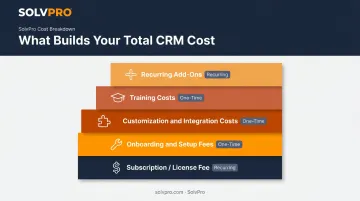
The advertised subscription price is rarely the full story. Total cost of ownership includes several layers:
- Subscription/license fee (recurring): Covers core platform access and base features. This is the number on the pricing page.
- Onboarding & setup fees (one-time): Ranges from $0 (self-serve) to $1,500-$2,000+ for guided implementation, depending on the vendor.
- Customization & integration costs (one-time/periodic): Custom workflows and connectors to accounting or payment systems can trigger extra charges, especially outside included integrations.
- Training costs (one-time/recurring): Either internal team time or paid certification programs. Some vendors, like HubSpot Academy, offer free training; others charge per session.
- Add-ons (recurring): SMS credits, premium support tiers, and extra automation modules stack on top of per-user pricing month after month.
Zoho's Premium support, for example, costs a recurring 20% of the subscription fee on top of the base plan. That's a meaningful add if you're already paying per seat.
SolvPro's model skips most of this layering entirely. QuickBooks Online sync, NMI payment processing, and onboarding are bundled into every tier at no extra charge, so the advertised price is close to what you actually pay.
Low-Cost vs High-Cost CRM — What's the Difference?
Every price point involves a tradeoff between what you gain and what you give up.
| Category | Lower-Cost CRM | Higher-Cost CRM |
|---|---|---|
| Feature depth | Contact management, basic pipeline | Automation, AI insights, forecasting |
| Support & onboarding | Self-serve, email support | Dedicated onboarding, account manager |
| Scalability | May require switching platforms later | Built to scale, but costs more per seat |
Free plans illustrate this ceiling well:
- HubSpot's free plan caps out at two users and one deal pipeline
- Zoho's free plan allows three users, 5,000 records, and five workflow automations
Both work fine until you outgrow the caps, at which point the upgrade jump can be steep.
Higher-cost platforms remove those ceilings but charge more per user, every month, indefinitely.
How to Choose the Right CRM for Your Budget
The right CRM cost reflects the plan that fits how your business actually operates, not the lowest sticker price you can find.
- Match must-have features to a tier before comparing prices. Service businesses need scheduling, job costing, and mobile field access. A cheap sales CRM without those features isn't actually cheap once you factor in a separate scheduling tool.
- Watch for per-seat cost creep. A plan that looks affordable at 3 users can double in cost by the time you hire your sixth employee. Flat-rate alternatives offer more predictable budgeting.
- Don't ignore onboarding, integration, and training costs. The monthly fee is only part of the bill; a $1,500-$2,000 setup charge changes the math fast.
For service businesses managing both office staff and field crews, stacking a separate CRM, a scheduling app, and an invoicing tool often costs more than a single platform built for the job.
SolvPro, for example, bundles these functions into one subscription:
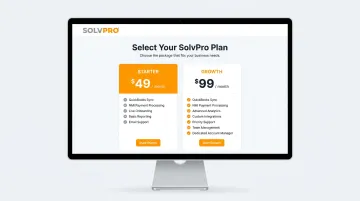
- Starter plan: $179/month for up to 3 users
- Growth plan: $228/month for 4 users, plus $49 per additional seat
- Every tier includes: QuickBooks sync, NMI payment processing, and live onboarding, with no long-term contracts
CRM cost depends heavily on pricing model, team size, and industry fit. Understanding the full picture, subscription plus setup plus add-ons, leads to a far smarter budgeting decision than comparing sticker prices alone.
Frequently Asked Questions
What is the average cost of a basic email-integrated CRM for a small service business in 2026?
Entry-level plans with email sync typically run $9 to $39 per user/month, depending on the vendor. HubSpot's Starter tier includes Gmail/Outlook sync even in its free plan, while full email tracking often starts around $14-$25/user on paid tiers.
Are there free or low-cost CRMs suitable for small service businesses?
Yes. HubSpot's free plan supports two users and one pipeline; Zoho's free plan supports three users and 5,000 records. Both cap automation and contact limits, forcing an upgrade once you scale past a few users.
How much does CRM software typically cost per month for a small business with a 5-person team?
Entry-level plans run roughly $45-$125/month for 5 users (HubSpot Starter to Salesforce Starter). Mid-to-high tiers with automation push that to $195-$450/month, depending on vendor and features.
What hidden costs should I budget for beyond the CRM subscription price?
Budget for one-time onboarding fees ($0-$2,000+), customization and integration charges, training time or certification costs, and recurring add-ons like premium support or SMS credits.
Is a per-user or flat-rate CRM pricing model better for a growing service business?
Per-user pricing works fine for small, stable teams. Flat-rate pricing usually saves more once you cross 5-8 users, since costs stop climbing every time you add staff.
How long does it take to implement a CRM for a small business?
It varies widely by vendor. Some platforms offer setup in under 10 minutes with live onboarding included, while others, like HubSpot Professional, quote a 60-day onboarding delivery window.