Introduction
Picture a plumbing crew that already schedules jobs, tracks hours, and sends invoices from one app. Now that same app can also process the payment, hold the funds, and even help finance next month's truck payment.
No separate merchant account. No second login for the bank. No third company to call when a lender says no.
That's the shift happening right now in field service software.
For years, growing service businesses have stitched together a payment processor, a bank, a lender, and their scheduling software separately. Each handoff adds delay, adds fees, and adds admin work that falls on whoever runs the office.
This guide breaks down what embedded finance actually means, why field service businesses are a near-perfect fit for it, and the four main types available today. It also covers what to look for when evaluating a platform, including how SolvPro builds these tools directly into its core product.
Key Takeaways
- Embedded finance builds financial services directly into your software, skipping outside providers
- Field service businesses face a job-to-cash gap that traditional banks rarely solve fast
- Four solution types exist: payments, lending, banking/payouts, and insurance/bonding
- The right platform pairs built-in processing, transparent pricing, and onboarding support
What Is Embedded Finance (And Why It's Different From Traditional Payment Processing)?
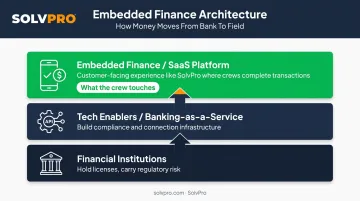
Embedded finance means financial services (payments, lending, banking, insurance) are built directly into the software a business already uses, rather than accessed through a separate provider. The financial transaction happens inside the workflow, not outside it.
Three players make this work:
- Financial institutions hold the banking licenses and carry regulatory risk
- Tech enablers build the API connections linking the software to those licensed institutions
- SaaS distributors are the field service platforms crews already log into every day, like SolvPro
How This Differs From the Old Model
Previously, a contractor needed a merchant account from one company, a business bank account from another, and financing from a third lender entirely. Each relationship required its own application, its own login, and its own support line.
Picture a landscaping crew waiting on a same-day loan for a broken mower during peak season. The office calls the lender, faxes bank statements, then waits two business days for an answer that arrives after the job is already lost.
Embedded finance consolidates that into one account. One dashboard shows the job, the invoice, and the payment status together, so the money question never leaves the platform.
Embedded Finance vs. Banking-as-a-Service
These terms get used interchangeably, but they're not the same thing. Banking-as-a-Service (BaaS) is the infrastructure and compliance layer, the back-end rails that connect a licensed bank to a nonbank platform. Embedded finance is the customer-facing experience built on top of that infrastructure.
Think of BaaS as the plumbing behind the wall. Embedded finance is the faucet the crew actually touches.
This isn't a niche trend anymore. Global embedded-finance transaction value is projected to grow from $92 billion in 2024 to $228 billion in 2028, according to Juniper Research's Embedded Finance Market Report. That's momentum across every industry that runs on software, and field service is squarely in that path.
Why Field Service Businesses Are Primed for Embedded Finance
Field service work has a timing problem that office-based businesses rarely deal with.
The Job-to-Cash Gap
Work gets finished on-site, but invoicing, approval, and payment often lag days or weeks behind. That gap strains cash flow right when crews need money for materials, fuel, or payroll. A landscaping crew that wraps up a job Friday afternoon shouldn't have to wait until the following week for someone in the office to generate and mail an invoice.
Crew Payment Friction
Multi-crew teams need fast, trackable ways to get paid or reimbursed for job-related expenses. Without embedded tools, that often means:
- Office staff manually cutting checks for reimbursements
- Crews fronting money for materials and waiting weeks to get repaid
- No clear audit trail connecting an expense to a specific job
The Admin Burden Is Real
Office staff at growing HVAC, plumbing, electrical, landscaping, and cleaning businesses spend hours reconciling payments across disconnected tools instead of running the business. Every extra system is another place data can go stale or get lost.
The Capital Access Gap
Getting approved for a truck loan or equipment financing isn't easy for small service businesses. Only 41% of small-employer firms that applied for a loan, line of credit, or merchant cash advance received all the financing they requested, according to the Federal Reserve's 2025 Report on Employer Firms. Another 24% received none at all.
Traditional banks weren't built to underwrite based on job history and real-time revenue data. Embedded finance platforms are.
When a field service platform becomes the single place jobs are scheduled, invoiced, paid, and financed, it also becomes harder to leave. Switching platforms no longer just means relearning scheduling software. It means giving up integrated money movement, which is a much bigger ask.
Types of Embedded Finance Solutions for Field Service SaaS
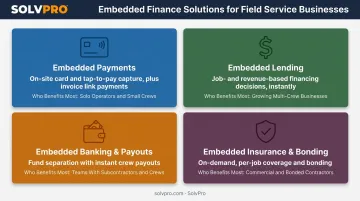
Not all embedded finance looks the same. Here's how the four main categories break down:
| Type | What It Does | Who Benefits Most |
|---|---|---|
| Embedded Payments | Captures payment on-site via card, tap-to-pay, or invoice link | Crews needing same-day payment |
| Embedded Lending | Uses job/revenue data for faster financing decisions | Owners buying trucks or equipment |
| Embedded Banking & Payouts | Separates job funds, speeds up crew/sub payouts | Multi-crew operations |
| Embedded Insurance & Bonding | On-demand coverage accessible per job | Trades needing flexible, short-term policies |
Embedded Payments
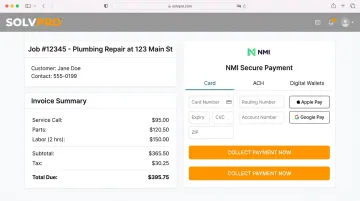
In-field payment capture, whether that's a card swipe, tap-to-pay, or an invoice link sent from the job site, lets crews get paid the moment a job wraps up. No mailed checks, no waiting for a customer to remember to log into a portal days later. SolvPro, for example, builds NMI payment processing directly into its invoicing workflow, so crews collect payment without switching apps.
Embedded Lending & Growth Capital
Platforms with visibility into a contractor's job history and revenue can make faster, more informed financing decisions than a traditional bank loan process allows. Housecall Pro's integration with Wisetack is a real example: once approved, financing options appear right on qualifying estimates and invoices, no separate loan application required.
Embedded Banking Accounts & Instant Payouts
Business bank accounts and instant payout features let owners separate job funds and pay subcontractors or crew members quickly, avoiding the multi-day wait typical of standard ACH transfers. Jobber's Instant Payouts feature, for example, moves funds that normally take two business days within minutes for an added 1% fee.
Embedded Insurance & Bonding
This is the newest of the four categories. On-demand liability coverage or bonding, accessible per-job directly through the platform, is useful for trades that need flexible short-term coverage rather than an annual policy. Housecall Pro's partnership with Coverdash connects users to carriers like The Hartford and Travelers directly inside the "My Money" tab.
Key Benefits of Embedded Finance for Growing Service Businesses
The value isn't theoretical. Independent research backs up why faster, integrated payments matter to business owners.
Key benefits include:
- Faster payment cycles: Cutting the gap between job completion and deposit improves day-to-day cash flow. A 2024 Federal Reserve survey of 2,000 U.S. businesses found 92% prioritize cash flow through faster payments, according to the 2024 Business Payments Study.
- Less admin time: Fewer manual reconciliation steps between banking, payment, and job management systems free up office staff for higher-value work instead of chasing invoices.
- Clearer job profitability: When payments and job costs live in the same system, owners see true margins per job instead of piecing together numbers from a spreadsheet, a bank statement, and a scheduling tool.
That's the difference between reacting to cash flow problems and spotting them before they happen.
How to Evaluate an Embedded Finance-Enabled Field Service Platform
Not every platform that claims "embedded finance" delivers it the same way. Ask these three questions before signing up.
- Is payment processing truly built in, or bolted on? A clunky third-party redirect that bounces crews and customers to another website adds steps and friction, defeating the whole point.
- Is the pricing transparent? Look for straightforward, SMB-friendly pricing rather than surprise add-on fees tacked onto payment or banking features after the fact.
- Who handles compliance and support? Confirm the provider manages security and regulatory requirements behind the scenes, and offers real onboarding help instead of leaving a small business to configure complex financial settings alone.
Industry research from the Institute of International Finance (IIF) and Deloitte reinforces this: platforms should clearly disclose who holds regulatory accountability, how customer recourse works, and how third-party risk is managed. If a provider can't answer those questions plainly, that's a red flag.
How SolvPro Brings Embedded Finance to Field Service Teams
SolvPro was built around the idea that financial tools shouldn't require a separate login just because the job did.
Payment processing lives inside the core platform. NMI payment processing is built directly into SolvPro rather than added as a separate integration, letting crews and office staff generate an invoice from the job site and collect credit card, ACH, or digital payment on the spot, with no separate merchant account setup required.
QuickBooks Online sync eliminates duplicate data entry. Job costing, labor hours, and financial reporting sync automatically with QuickBooks, cutting the manual bookkeeping that office teams currently repeat across disconnected tools.
No surprise fees, no long-term contracts. NMI payment processing and QuickBooks sync are built into every SolvPro plan, with no add-on charges for either feature:
- Starter: $179/month for up to 3 users
- Growth: starting at $228/month for 4+ users
- Scale: custom pricing for larger operations
Built for the whole crew, not just the office. SolvPro's bilingual English/Spanish interface extends across scheduling, invoicing, and payment collection, so language never becomes a barrier to getting paid. That same crew-first approach carries into onboarding: live, human setup support replaces a chatbot and knowledge base, with most teams up and running in under 10 minutes.
That's the same philosophy driving embedded finance industry-wide: financial tools should be simple and accessible for every crew, not reserved for enterprise operations with dedicated finance departments.
Frequently Asked Questions
What is embedded finance in simple terms?
It's financial services, like payments or lending, built directly into software a business already uses, instead of requiring a separate bank or provider. The transaction happens inside the platform you're already logged into.
How is embedded finance different from just accepting card payments through a payment processor?
Basic card acceptance is one piece of embedded finance. The fuller model can include banking, lending, and instant payouts, all inside the same platform rather than spread across separate accounts.
Is embedded finance secure for small field service businesses?
Yes. Licensed financial institutions and compliant tech partners handle the security and regulatory requirements behind the scenes, so the business owner isn't left managing that risk alone.
Can embedded finance help contractors get paid faster on job sites?
Yes. In-field payment capture and instant payout features can shorten the gap between finishing a job and seeing the funds land in the business's account.
Do I need a separate merchant account if my field service software has embedded finance?
Platforms with built-in processing, like SolvPro's NMI integration, eliminate the need for a standalone merchant account, since payments run directly through the platform.
What should a growing service business look for in an embedded finance-enabled platform?
Look for transparent pricing, real onboarding support, and integrations like QuickBooks sync, all signs of a platform built for SMBs rather than enterprise-level complexity.