Introduction
"What is my business actually worth?" Every septic, sewer, or wastewater O&M owner asks this eventually, usually right before they decide to sell.
The problem is most online answers don't fit. Search results either target $50M+ municipal contractors or throw generic small-business rules of thumb at you that ignore permit compliance, aging vac trucks, and regulatory risk.
Wastewater businesses value differently. A one-truck septic pumping operation and a 15-year municipal O&M contractor don't belong on the same multiple chart.
This guide breaks down what actually moves the needle:
- The valuation methods used for wastewater businesses
- Factors that move your multiple up or down
- A worked example using real numbers
- Practical steps to raise your value before you sell
Key Takeaways
- Owner-operated wastewater businesses typically sell for 2x to 4x SDE
- Larger O&M contractors earn higher EBITDA multiples from recurring municipal revenue
- Clean financials and low customer concentration are your biggest value levers
- Professional valuations pay off pre-sale, but you can benchmark yourself first
What Is a Wastewater Management Business Worth? Valuation Methods and Multiples
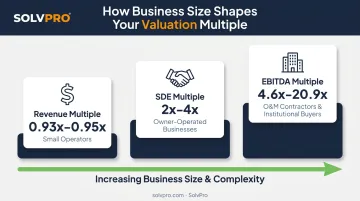
Value gets expressed as a multiple of one of three things: revenue, Seller's Discretionary Earnings, or EBITDA. Which one applies depends almost entirely on your size and how your operations are structured.
Small owner-operated businesses lean on revenue or SDE. Larger operations with a management layer and diversified contracts get valued on EBITDA. Here's how each works.
Revenue Multiples
Revenue multiples are a quick screening tool, nothing more. They tell a buyer roughly where a business might land before anyone opens the books.
For adjacent local waste-service businesses sold on BizBuySell, average revenue multiples came in around 0.93x to 0.95x, with median revenue near $710,000. That's a useful proxy for small wastewater operators, though it's not a septic-specific figure.
Why revenue multiples fall short: they ignore cost structure entirely. A business with 60% margins and one with 25% margins can post identical revenue yet sell for very different prices. Use revenue multiples to sanity-check a number, not to set your asking price.
Seller's Discretionary Earnings (SDE) Multiples
SDE is the primary valuation metric for owner-operated wastewater businesses. It starts with net profit, then adds back owner salary, personal expenses run through the business, and one-time costs. The result shows the true cash flow available to a single working owner.
That same BizBuySell dataset shows sold waste-management and recycling businesses averaging 3.25x to 3.31x SDE. That range supports the commonly cited 2x-4x SDE benchmark for small wastewater operators, though the exact endpoints shift with each business's specifics.
Businesses that land toward the top of that range typically show:
- Consistent margins over multiple years, not one good year
- Revenue diversified across service types (pump-outs, installs, inspections, repairs)
- Clean, verifiable books that don't require heavy buyer adjustments
EBITDA Multiples
EBITDA multiples apply once a wastewater business scales into contract-based O&M or industrial work, backed by a management team rather than a single owner doing everything.
This is where the "what's the EBITDA multiple for waste management" question gets messy, because there's no single answer. The range depends heavily on buyer type and company scale:
| Buyer/Company Type | EBITDA Multiple | Source Year |
|---|---|---|
| Private-equity environmental services deals | 4.6x median | 2024 |
| Strategic environmental services deals | 15.0x median | 2024 |
| Strategic environmental services deals | 20.9x median | 2025 |
| Public waste management companies | 15.0x median LTM | 2025 |
The jump from SDE-level pricing to EBITDA-level pricing doesn't happen automatically at a revenue threshold. It requires reduced owner dependency, diversified contracts, and financial systems solid enough that a buyer's diligence team trusts the numbers without a six-month forensic dig. Field service platforms like SolvPro that keep job costing, invoicing, and books synced with QuickBooks make that financial credibility easier to build well before a sale.
Key Factors That Drive Your Wastewater Business Valuation
Six factors do most of the work in setting where your business lands within its multiple range. Get these right and you push toward the top of the range. Get them wrong and no amount of revenue growth saves you.
Contract mix and customer concentration. Long-term municipal, HOA, or commercial service contracts get valued higher than one-off residential calls. Any single customer representing a large share of revenue caps your achievable multiple, regardless of how profitable the business looks on paper. For buyers, that concentration reads as inherited risk, and risk shrinks your multiple.
Licensing, permits, and regulatory compliance. Valid septic or wastewater operator licenses, clean discharge and permit records, and zero open violations are baseline requirements. This gets checked before buyers even discuss top-of-range multiples, and missing licenses or open violations stop that conversation cold.
Equipment and fleet condition. Vac trucks, jet trucks, pumps, and treatment equipment carry real replacement costs. Deferred maintenance shows up as a direct, often dollar-for-dollar, deduction from purchase price. Expect a serious buyer to model capex needs for the next three years and price accordingly.
Recurring vs. project-based revenue. Service agreements and maintenance contracts get valued higher than emergency or one-time installation work. Buyers pay a premium for that predictability.
Owner dependency. A business where the owner handles every sales call, schedule change, and customer relationship gets discounted for key-person risk. Delegating those responsibilities to a GM or lead crew that runs day-to-day operations independently commands a real premium instead.
Financial recordkeeping and systems. This is where most valuations lose value without the owner ever noticing. Lenders and buyers discount businesses running on paper tickets, spreadsheets, and disconnected invoicing systems, because those setups signal unreliable numbers and slow, expensive due diligence.
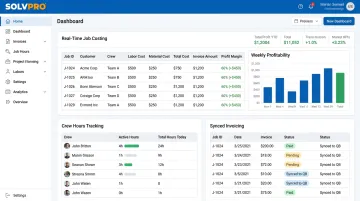
A centralized field service platform changes that picture. SolvPro, for example, tracks job costs, crew hours, and invoicing in real time, so every job carries its own profitability data rather than getting buried in a monthly spreadsheet reconciliation. That kind of job-level detail is exactly what a buyer's accountant wants to see during diligence.
How to Calculate Your Wastewater Business Value: A Step-By-Step Example
Numbers make this concrete. Here's a realistic example based on a small septic/wastewater service business with $700,000 in annual revenue, a size that's typical for wastewater businesses that come up for sale.
Step 1: Normalize your earnings.
Start with net profit as reported. Then add back:
- Owner's salary
- Personal vehicle and phone expenses run through the business
- One-time equipment repairs
- Any other non-recurring costs
Say this business shows $95,000 in net profit. After adding back a $65,000 owner salary, $8,000 in personal vehicle expenses, and $12,000 in one-time repairs, normalized SDE comes to $180,000.
Step 2: Select a starting multiple.
Based on the 2x-4x SDE range established earlier, this business's profile matters:
- 70% recurring service contracts, 30% one-off calls
- One customer at 20% of revenue (below concerning concentration levels)
- Fleet is five years old with documented maintenance records
That profile suggests a starting point around 3.0x.
Step 3: Apply adjustments.
- +0.2x for documented recurring contracts above industry average
- +0.15x for clean financial systems and job-level cost tracking
- -0.1x for one aging vac truck needing replacement within 18 months
Adjusted multiple: 3.25x
Step 4: Calculate indicative value.
$180,000 SDE × 3.25 = $585,000 indicative value.
Modest operational improvements shift this range meaningfully. Diversify that customer base further and clean up equipment records, and the same $180,000 SDE at a 3.6x multiple pushes value to $648,000. That's a swing of over $60,000 from operational changes alone, not revenue growth.
How to Increase Your Wastewater Business Value Before Selling
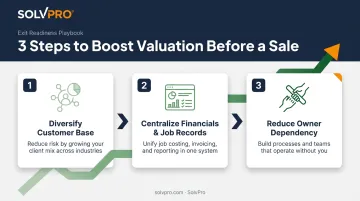
Owners often assume the only lever is growing revenue. It isn't. These three moves typically deliver the biggest impact in the shortest window.
Diversify your customer and contract base over 12-24 months. Prioritize multi-year service agreements over one-off calls. Reducing concentration risk from any single large customer directly widens your achievable multiple range.
Clean up and centralize your financials and job records. Moving off paper tickets and spreadsheets into a system that tracks job profitability, crew time, and invoicing gives buyers and lenders the transparent data they need to trust your numbers. Platforms like SolvPro capture this automatically as work happens in the field.
Reduce owner dependency. Document standard operating procedures and train a lead technician or manager who can run day-to-day operations without you on every call. Even partial delegation signals lower key-person risk to a buyer.
Common Mistakes That Hurt Wastewater Business Valuations
Three mistakes show up again and again during due diligence, and each one costs real money at closing.
- Commingling personal and business expenses. When personal spending runs through business accounts, buyers can't trust the reported earnings and often discount heavily or walk away entirely.
- Letting equipment and permits lapse. Deferred maintenance and compliance gaps aren't negotiable line items; they're direct, dollar-for-dollar deductions from purchase price.
- Relying on a single large customer or municipal contract. No matter how profitable the business looks, heavy reliance on one revenue source caps the achievable multiple, since buyers price in the risk of losing that contract.
Frequently Asked Questions
What is the EBITDA multiple for waste management?
It varies widely by scale and contract type, from roughly 4.6x for private equity deals to 15x or higher for strategic acquisitions and public companies. Most small owner-operated businesses are valued on SDE, not EBITDA.
How much should I pay for a business valuation?
A basic broker or online estimate is often free. A certified formal valuation, useful for financing, partnership buyouts, or estate planning, typically runs a few thousand dollars depending on business complexity.
What's the difference between an SDE multiple and an EBITDA multiple?
SDE assumes one working owner and applies to small businesses. EBITDA assumes a management team already runs the business, and applies to larger, more institutional-scale operators.
Is a septic or sewer service business valued differently than a municipal wastewater treatment operation?
Yes. Septic and sewer businesses use SDE multiples like other local service companies. Municipal O&M contractors with long-term contracts command higher EBITDA multiples due to recurring, escalator-backed revenue.
Do I need a professional appraisal to sell my wastewater business?
It's not legally required, but it strengthens your negotiating position and supports financing. Serious buyers and lenders often request one before moving forward.
What's the fastest way to increase my business's value before selling?
Diversify your contracts, clean up financial records with a centralized system, and reduce owner dependency. These three moves deliver the highest impact in the shortest timeline.